

Stress is not harmful—until it is. What begins as a normal, even protective response in the body can slowly shift into something more persistent, more draining, and far less supportive. Over time, ongoing stress activation keeps your system in a heightened state, making it harder to rest, recover, or feel like yourself again. This is the turning point—when stress crosses a threshold and becomes something toxic, that needs your attention. (A previous post explored some statistics to consider the likely prevalence of psychological injuries).
| This post is part of a series: stress and trauma |
The realities of “stress” and “toxic stress” became more public during the Covid 19 pandemic as they became part of the social conversation in a way that they hadn’t been before.
My vantage point during that time was supporting about 3300 executives, managers, and frontline continuing care staff regarding stress, resiliency, and stress recovery. We were one of the hardest hit areas in healthcare because of the vulnerability of residents, contagion of the virus, and proximity of residential living, with many outbreaks and hundreds of deaths.
“Stress” was talked about in the news regularly. Experts from various disciplines spoke to it. All kinds of people put forth strategies and to do lists to deal with it, especially on podcasts and various social media platforms.
The larger conversation was necessary and important. But there was an outpouring of sometimes overly simplistic and contradictory content, which in and of itself started to add to the overwhelm.
Understanding how “stress” works is critical to understanding ourselves and what’s going on inside us, including if we’ve reached the point of toxic stress. To this end, I’d like to provide an overview of what I believe is most important to know about stress and toxic stress.
Stress is Normal and Necessary
Stress is normal. Our nervous systems are designed to govern our brain and body’s response to demands, challenges, threats and danger.
Stress is also necessary. The process is designed to ensure our safety and well-being. It helps us play. It helps us meet deadlines. It helps us respond rapidly to an impending car accident. It helps us survive serious dangers and threats.
Thinking About Stress as a Process
The word “stress” is used as an overarching term but it’s clumsy.
I think about stress more as a process, but it’s not linear. It’s a complex of variable factors that is continually being automatically and unconsciously assessed and reassessed by the nervous system- particularly the limbic brain and brain stem.
The process is comprised of:
- Stressor(s) which are essentially challenges, demands, threats, or dangers. All day, every day, we are faced with stressors. They can be internal, arising in our own bodies, needs, emotions, thoughts. They can be external, happening outside of us, in our relationships and experiences. They can be challenges or demands on our bodies, our energy levels, our capabilities, our sense of balance, our way of seeing things. They can be threats or dangers to our safety, our needs being met, our identity, our core beliefs, our integrity. Stressors vary in terms of such things as source, type, tense, intensity, duration. When stressors are unpredictable, severe, prolonged, uncontrollable, urgent and threatening to primary needs, they are much harder to tolerate.
- Stress Appraisal/ Neuroception which is the responsibility of the nervous system. The limbic brain and brain stem are responsible for continuous scanning/surveillance of safety versus absence of safety, challenge, demand, danger, and threat, internally, externally and relationally. Neuroception is a fine tuned, highly sensitive smoke detector.
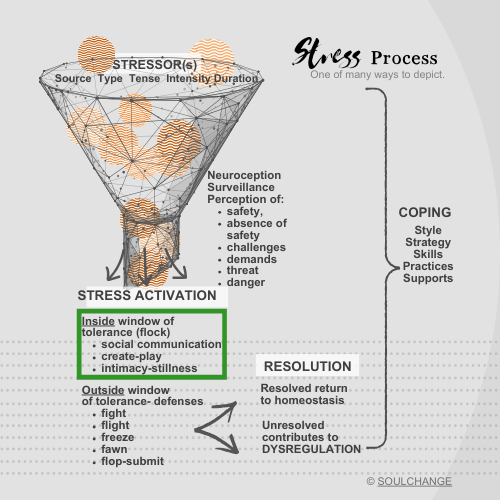
- Stress Activation/ Arousal- Based on neuroception, nervous system circuits are activated to respond to the actual or perceived absence of safety; challenge, demand, danger, and threat to ensure overall safety and well-being. Activation is the result of the release of various neurochemicals, e.g., cortisol, norepinephrine, glutamate. Overall, according to the Polyvagal Theory, the nervous system has three circuits with different strategies: ventral vagal (social engagement), sympathetic (mobilization-defense) and dorsal vagal (immobilization-defense). They combine into six distinct different nervous system states and various other combinations depending on the degree to which each branch is activated/engaged. Stress activation does not automatically result in the nervous system dropping into one of survival defense states of mobilizing or immobilizing. Each person can tolerate, manage or cope with a certain amount of lack of safety; challenge, demand, threat, and/or danger and the corresponding stress activation while staying socially engaged or within their window of tolerance.
- Resolution of Stress Activation. The nervous system is designed to be in states of arousal/activation on a short-term basis to address an absence of safety; challenge, demand, danger or threat. In a healthy system, arousal/activation resolves once demand, danger, or threat has passed. This occurs naturally, as the stress appraisal/neuroception in the limbic brain and brain stem automatically and continually recalibrates and recognizes restored safety. Under certain conditions, the ability for resolution can become thwarted.
- Coping. Coping is the conscious and unconscious effort we put in to solve problems and reduce stress to try and restore a state of optimum functioning. The coping style, and various strategies, skills, practices, and supports we utilize interact with stressors, stress appraisal, stress activation, and stress resolution.

There is Wide Diversity in Stressors, Activation and Tolerance, Resolution and Coping
A common phrase that was used frequently in the news and social media in the early months of the pandemic was, “we’re all in the same boat”. Meaning, we’re all living in a pandemic world with the fear and risk of infection to ourselves and loved ones, with restrictions, and with extra stressors.
While well intended, at its best, this comment was a gross oversimplification. At its worst, it disregarded the diverse reality of what different people and groups of people were dealing with.
In my opinion, we were not/are not ever all in the same boat. Different people and groups of people were in everything from ocean liners to cruise ships, to yachts, to barges, to submarines, to motorboats, to kayaks, to jet skis, to homemade, patched together life rafts continually bailing water to stay afloat.
Further, I would argue that we were not even experiencing the same part of the storm. Different people and groups of people were in everything from overcast conditions, to light rain, to stormy conditions, to hurricanes, to the eye of the storm.
The point that is entirely missed in the phase “we’re all in the same boat”, is that while the core components of the stress process (stressors, stress appraisal, stress activation, resolution, coping) are the same for all of us, there is enormous diversity among people and groups of people for every component.
Yes, we all have stressors. But we don’t have the same types of stressors, the same intensity of stressors, or the same duration of stressors.
Yes, we all have stress appraisal. But how our neuroception or stress appraisal system assesses incoming stressors varies widely based on a lot of factors such as our physical size; our gender; our race; the social messages we have absorbed; our level of power and control; our personal history; our emotional learning; our capabilities, like self-regulation; the physical environment; our attachments to others, and whether we are facing things alone or not, etc., etc., etc. Further, our neuroception is also informed by the degree of stress activation already present in our nervous system, whether it is from current/present day stressors or unresolved stress and trauma(s).
Yes, we all have stress activation and the same nervous system hierarchy of social engagement and survival defenses, but how stress activation and the nervous system respond varies significantly. Our window of tolerance, or how much stress activation we can handle while staying in a pro-social state is widely different. Some of us can handle a lot of stress activation, others much less. An aspect of this goes all the way back to childhood and whether we had a caregiver who supported us to regulate our nervous system when we became dysregulated. This process supports us to develop the capacity to regulate it for ourselves. Without this, we move out of our window of tolerance much more readily and drop into defensive survival states until we develop the skills to regulate ourselves.
Yes, we all have coping style, strategies, skills, practices, and supports that we utilize consciously and unconsciously to handle problems and deal with stress, but there is wide variety in them and their effectiveness relative to the stressors, and the degree of stress activation and resolution.
The takeaway is, that because of the interplay of all this diversity in the components of the stress process, we don’t all experience or respond to stress in the same way. Not even close.
Recognizing this diversity among people is important. And, perhaps even more important is reflecting on and knowing our own diversity and how it impacts our nervous system, our experience of stress, and our vulnerability to toxic stress.

Toxic Stress and It’s Effects (Toll)
The wide diversity in how people experience and respond to stress is especially relevant when it comes to toxic stress. Stress becomes toxic when there is excessive or prolonged activation of stress response in the brain and body.
The circumstances under which this might happen are many. And for those whose diversity compromises them in the first place, the risk of experiencing toxic stress is higher.
It’s toxic because the excessive or prolonged stress activation affects such things as:
- our brain’s ability to think, problem solve, create, remember, learn, be attentive and focused, and to be motivated at home, at work, at school.
- our relational ability to be connected and engaged with others, have empathy, know and express our emotions, and develop and participate in healthy, safe, reciprocal relationships.
- our coping ability to respond rather than being reactive or disengaged and to practice self-care and use healthy coping skills.
- our body’s ability to regulate mood, hunger, body temperature, energy levels, sleep and removing toxins from the brain during sleep.
Toxic stress often results in a dysregulated nervous system. This means the nervous system no longer functions optimally. It may alter neuroception and stress appraisal. It almost always narrows the window of tolerance, meaning that the amount of stress we can handle lessens. And, it often reduces the nervous system’s ability to resolve stress activation once stressors have passed, instead, it remains stuck in an activated state.
These impacts tend to ripple into other impacts on relationships, work, finances.
If left unaddressed, toxic stress can also contribute to inflammation, as well as immune and endocrine system changes. It acts like a physiological kindling process through time that results in one or multiple physical health issues. Toxic stress has been linked to a far greater likelihood of a variety of diseases, including but not limited to cancer, lung disease, diabetes, asthma, headaches, autoimmune disease, fibromyalgia, tumors, depression, ulcers, chronic obstructive pulmonary disease, ischemic heart disease, multiple sclerosis, lupus, and irritable bowel syndrome.
Getting Real and Dealing with the Toll of Toxic Stress
It can be very hard to recognize the toll of toxic stress. It’s hard to see it when we’re in the middle of it. We are just head down, trying to survive and get to the other side of whatever the circumstances are. We often think we have more left in our tank than we do. The more stressed we are, the less self-aware we are, so the less accurately we assess our functioning and the true impact the prolonged stress is having.
Unfortunately, this means we are unlikely to see the toll until things have gotten pretty bad. Or perhaps, we saw the toll and tried to make changes, but they didn’t help, or they didn’t help in time, or enough. Or maybe, we have an ongoing stressful circumstance such as caring for a high needs dependant without enough supports that has caught up to us. Or maybe, we just had a downpouring of significant stressors that were beyond our control.
The result is the same. The toll of toxic stress has reached the point where our nervous system is dysregulated and needs support to recover. It might have labels like burnout, compassion fatigue, or chronic fatigue.
We deal with the toll by entering a winter season and focusing on restoring.
We patiently focus on the renewal of our worn-out nervous system and slowly bring it back to equilibrium. This means reducing stressors and significantly increasing self-regulation.
We reflect on the context and circumstances of the toxic stress, and any role we may have had. We make changes, including in ourselves to ensure our safety and well-being going forward.
We release people, circumstances, and old ways of handling things while adapting and expanding our coping strategies and skills.
We resource ourselves with information, inspiration, and professional support to help us recover.
If you’ve found yourself in a toxic stress filled winter, even though it’s hard, lean in. The more you do, the faster you will move through it and find yourself able to meet spring from a place of renewal.
With Humility, Hope, and Heart,

SOURCES:
Arnsten, A.F. T. (2009). Stress signaling pathways that impair prefrontal cortex structure and function. Nature reviews. 10, 6, 410-422.
Burke Harris, N. (2018). The Deepest Well. Healing the Long-Term Effects of Childhood Adversity. New York: Mariner Books.
Gentry, J.E. & Dietz, J.J. (2020). Professional Resilience: Prevention and Resolution of Burnout, Toxic Stress and Compassion Fatigue. Outskirt Press.
Gilgoff, R., Schwartz, T., & Owen, M. et.al., (2023). Opportunities to Treat Toxic Stress. Pediatrics. 151(1)
Jackson Nakazawa, D. (2015). Childhood Disrupted. How Your Biography Becomes Your Biology and How You Can Heal. New York: Atria.
Karr-Morse, K. (2012). Scared Sick. The Role of Childhood Trauma in Adult Disease. New York: Basic Books.
Leung, C.W., Odoms-Young, A. & Essel, K. (2024). Food Insecurity Is a Source of Toxic Stress. JAMA Pediatr. 178;(4):327-328.
Maté, G. (2008). In the Realm of Hungry Ghosts. Close Encounters with Addiction. Toronto: Knopf Canada.
Motherwell McFarlane, J., Liangzi Shi, A. Ramoo, D. & Yousef, T. (2024). Stress and Health. (pgs. 935-954). Introduction to Psychology: Moving Towards Diversity and Inclusion. Canadian Edition. Victoria, B.C.: BC campus. Retrieved from https://opentextbc.ca/introductiontopsychology/
Motherwell McFarlane, J., Liangzi Shi, A. Ramoo, D. & Yousef, T. (2024). Stress and Illness. (pgs. 955-962). Introduction to Psychology: Moving Towards Diversity and Inclusion. Canadian Edition. Victoria, B.C.: BC campus. Retrieved from https://opentextbc.ca/introductiontopsychology/
Motherwell McFarlane, J., Liangzi Shi, A. Ramoo, D. & Yousef, T. (2024). Regulation of Stress. (pgs. 975-994). Introduction to Psychology: Moving Towards Diversity and Inclusion. Canadian Edition. Victoria, B.C.: BC campus. Retrieved from https://opentextbc.ca/introductiontopsychology/
Nelson, C.A., Bhutta, Z. A., Burke Harris, N., Danese, A., & Samara, N. (2020). Toxic Stress and PTSD in Children. Adversity in childhood is linked to mental and physical health throughout life. BMJ, 371:m3048 | doi: 10.1136/bmj.m3048
Shonkoff, J.P., Slopen, N., & Williams, D.R. (2021). Toxic Stress, and the Impacts of Racism on the Foundations of Health. Annu. Rev. Public Health, 42:115–34.
Stangor, C. and Walinga, J. (2014). Health, Stress, and Coping. (pgs. 734-745) Introduction to Psychology – 1st Canadian Edition. Victoria, B.C.: BC campus. Retrieved from https://opentextbc.ca/introductiontopsychology/
Stangor, C. and Walinga, J. (2014). Stress and Coping. (pgs. 746-773), Introduction to Psychology – 1st Canadian Edition. Victoria, B.C.: BC campus. Retrieved from https://opentextbc.ca/introductiontopsychology/
Stangor, C. and Walinga, J. (2014). Stress: The Unseen Killer. (pgs. 480-502) Introduction to Psychology – 1st Canadian Edition. Victoria, B.C.: BC campus. Retrieved from https://opentextbc.ca/introductiontopsychology/