

What if what you’ve been carrying isn’t just run of the mill “stress”—but something far more pervasive, patterned, and wired into your system? Toxic stress and trauma are not rare, isolated experiences; they are far more common than most of us realize, often shaping how we think, feel, and relate to ourselves and others (and often beyond our awareness). Research suggests that a majority of adults have experienced at least one form of significant adversity if not more , yet many of us move through life without fully recognizing its imprint. This isn’t about labeling or pathologizing—it’s about gently bringing awareness to what may already be influencing your nervous system, your relationships, and your sense of self, so that meaningful recovery can begin.
| This post is part of a series: stress and trauma |
Admittedly, understanding the prevalence of things like toxic stress and trauma is considerably complicated for a whole bunch of reasons, some of which I am going to get into here.
Having said that, I’m going to do my best to simplify it and do it justice within the limited space of a blog post.
See if you can lean in with head and heart as I walk through the facts and some of the issues. I’m hoping you can make some space within yourself for the probable prevalence of toxic stress and trauma. It’s a little heavy with statistics, so it might be a good idea to pace yourself.
Note: I’ll be bringing in some international, as well as Canadian statistical information.

Known Prevalence of Trauma
A good starting point is to look at the incidence of diagnosed, reported symptoms of post-traumatic stress disorder. It’s reported at between 3.9 and 12%. These are instances where the diagnosis tells us people have been propelled into survival.
- 3.9% of the world population has experienced post-traumatic stress disorder at some point in their lives. (WHO)
- 8% of adults meet the criteria for probable post-traumatic stress disorder and 5% report having PTSD that was diagnosed by a health professional. (Canada)
- 5% to 6% of men and 10% to 12% of women suffer from PTSD (United States).
It is generally recognized that trauma is underdiagnosed, so we know it happens more than the statistics tell us.
I believe this is the case for a variety of reasons. There is still social stigma attached to mental health challenges, which limits people’s willingness to seek support. Some people believe that trauma cannot be treated, so don’t bother seeking diagnosis and support. The larger cultural message of functioning and productivity does not encourage acknowledging when we are not okay. Many people may not recognize that they have trauma and therefore do not seek diagnosis or treatment. This is especially true for adults who have been functioning with complex trauma since childhood. It is very difficult for them to recognize it, because living inside the symptoms is so familiar for them.

Known Prevalence of Significant Threats / Harm to Safety, Security and Survival
Another helpful place to look is at a sampling of some statistics on the known prevalence of significant threats / harm to safety, security, and survival, because we know this is what typically propels people into survival.
The prevalence of individuals experiencing a potentially traumatic event varies from 63-90%.
- The WHO reports that 70% of people globally will experience a potentially traumatic event during their lifetime.
- Internationally, 70% of adults report experiencing lifetime traumas with an average of 3.2 traumatic experiences (based on multiple worldwide surveys of exposure to traumatic events including the World Mental Health Survey Consortium, which derived survey data from 24 countries).
- 90% of adults report exposure to at least one potentially traumatic event (PTE) during their lifetime (United States).
- Almost two-thirds (63%) of adults reported that they had been exposed to a potentially traumatic event at some point in their lives. (Canada)
There are of course, dozens of categories of the types of significant threats to safety, security, and survival that occur. I am going to look more closely at the prevalence of childhood maltreatment, specifically because children, due to high susceptibility, are more likely to suffer from toxic stress and develop trauma, including complex trauma.
- 60% of children under 5 years of age regularly suffer physical punishment and/or psychological violence at the hands of parents and caregivers. (International Studies)
- 60% of children aged 2–14 years experienced corporal punishment by adults in their households in the past month. On average, 17% of children experienced severe physical punishment (being hit on the head, face, or ears; or hit hard and repeatedly) but in some countries this figure exceeds 40%. (UNICEF’s data from nationally representative surveys in 56 countries 2005–2013)
- 59.7% of individuals experienced at least one type of childhood maltreatment (e.g., physical, sexual, and emotional abuse; interpersonal aggression; exposure to physical intimate partner violence [IPV]; emotional and physical neglect) before age 15. Approximately one-third (32.3%) of individuals experienced only non-physical types of child maltreatment (e.g., emotional abuse, interpersonal aggression, exposure to physical IPV, emotional and physical neglect), while more than 2 in 10 experienced both non-physical and physical maltreatment. (2018 Survey of Safety in Public and Private Spaces- Canada).
- 1 in 5 girls and 1 in 7 boys report having been sexually abused. (WHO).
- 34% of individuals experienced sexual abuse while they were under the age of 18 including just under one in two girls (44%) and one in four boys (24%) (Alberta Study).
- The rate of police-reported incidents of online sexual exploitation of children (luring, non-consensual distribution of intimate images, invitation to sexual touching, other) more than tripled, increasing from 50/100,000 in 2014 to 160/100,000 in 2022.
- 40 million take down notices were issued for the removal of child sexual abuse material (Project Arachnid locates child sexual abuse content on the internet and takes action to have the material removed and to support child victims- 15 countries).
- 42% of boys and 37% of girls were exposed to bullying (study of 40 developing countries).
- More than 230 million girls and women alive today have undergone female genital mutilation (FGM) in 30 countries in Africa, the Middle East, and Asia where FGM is practiced. (WHO)
Of course, we know that these findings are very likely only a reflection of the prevalence of childhood maltreatment. But even so, they indicate that 60% of children experience maltreatment of some kind in their household and often multiple kinds. And that within this, upwards of 30% experience sexual abuse; sexual abuse that, more and more, is being captured graphically and uploaded to the internet, causing them further harm.

Known Prevalence of Symptoms Associated with Toxic Stress and Trauma
I believe another factor that results in a lower prevalence of diagnosed toxic stress and trauma is that many individuals seek healthcare support for their various symptoms, not recognizing how the symptoms might fit together. Then, the symptoms get treated, without exploring or recognizing that toxic stress and trauma may be the underlying cause.
To be fair, our knowledge of toxic stress and trauma has increased considerably in the last few decades. We now have a much better understanding of the neurophysiology of its processes that impact the brain and body leading to short term and longer-term symptoms. For example, the heightened stress activation and dysregulation in the nervous system that are part of trauma essentially act like kindling through time for the development of stress and inflammatory related conditions.
I want to be clear that I am not suggesting that every condition that aligns with trauma symptoms means the individual has underlying trauma. What I am saying, is that I think it is probable that at least a reasonable portion of the conditions that are being treated and overlap with trauma symptoms likely reflect unrecognized, unresolved, and underlying toxic stress, trauma, or adversity.
- 4% of the global population (301 million people) experience anxiety disorder, making anxiety disorders the most common of all mental disorders. (WHO)
- An estimated 3.8% of the population experience depression, including 5% of adults (4% among men and 6% among women), and 5.7% of adults older than 60 years. (WHO)
- Approximately 1 in 150 adults (40 million people, or 0.53% of the global population) were living with bipolar disorder. (WHO)
- 400 million people, or 7% of the world’s population aged 15 years and older, lived with alcohol use disorders. Of this, 209 million people (3.7% of the adult world population) lived with alcohol dependence. (WHO)
- 1.2% of the world’s adult population has a gambling disorder. Around 5.5% of women and 11.9% of men globally experience some level of harm from gambling.
- Almost half (45.1%) of individuals were living with at least one major chronic disease (Canada, 2021).
If you’re interested in learning more, here are three books that build on the Adverse Childhood Events research and really detail the connection between underlying adverse childhood events, toxic stress and trauma, and the underlying physiological kindling process that results in various conditions such as: heart disease, cancer, autoimmune disease, fibromyalgia, depression etc.
Childhood Disrupted. How Your Biography Becomes Your Biology and How You Can Heal by Donna Jackson Nakazawa.
The Deepest Well. Healing the Long-Term Effects of Childhood Adversity by Nadine Burke Harris.
Scared Sick. The Role of Childhood Trauma in Adult Disease. Karen Karr-Morse.
Trauma as a Hidden Epidemic
Gabor Maté and Bessel van der Kolk, among others, contend that trauma is a hidden epidemic, meaning there is far more trauma than is recognized.
I agree.
Once you understand toxic stress and trauma and how they occur, it is hard not to see it.
The question then becomes, are we willing to see it?
In ourselves?
Our relationships?
Our schools?
Our leaders?
Our communities?
Our systems?
Our societies?
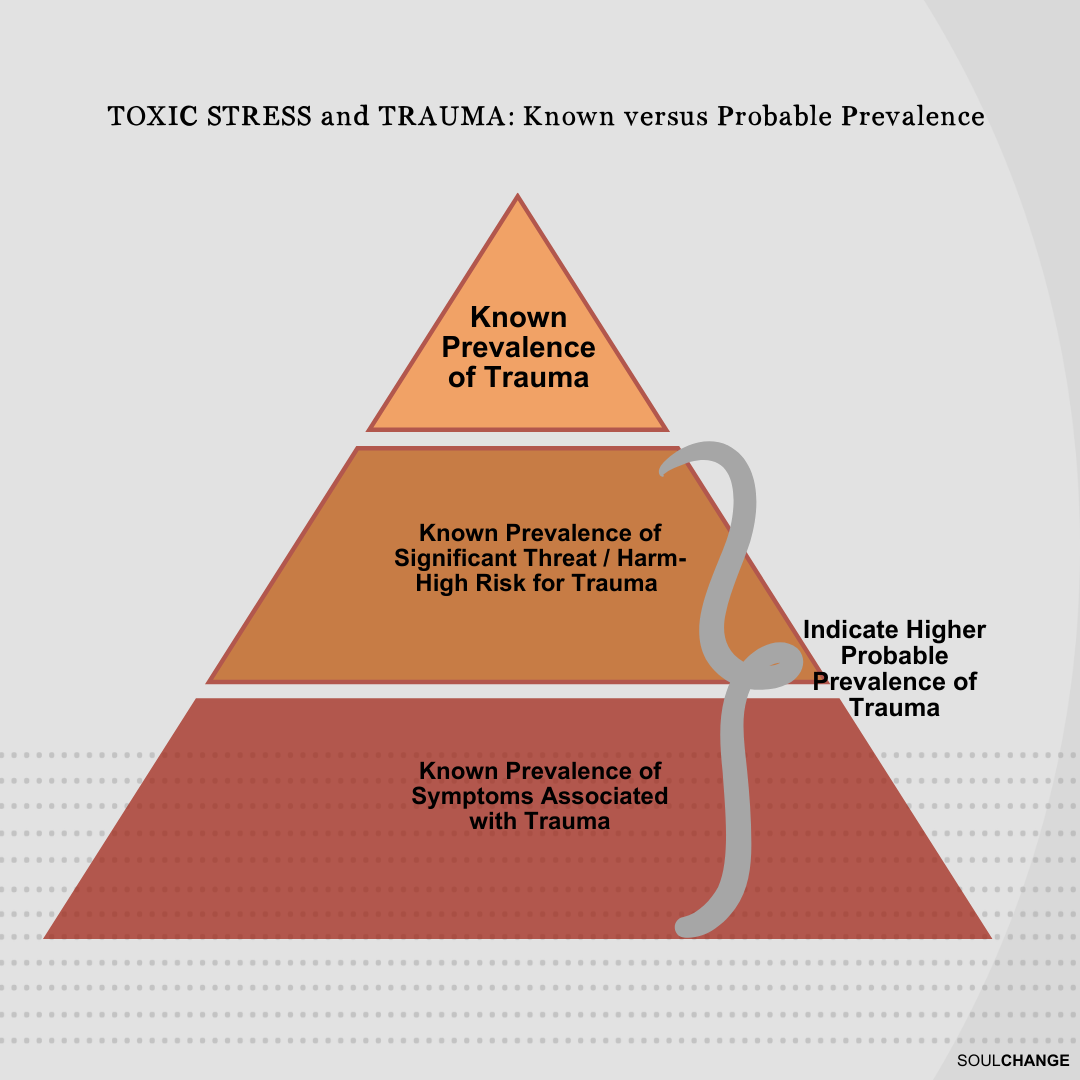
I’m not at all suggesting that we need to see the extent of toxic stress and trauma as the be all end all explanation of all things. But rather, we need to see it more accurately as a fairly commonly occurring cause of and response to a whole host of circumstances that reflect the realities of our childhoods, our relationships, our systems, and our societies.
Essentially, we need to see the prevalence of the profound winter.
With Humility, Hope, and Heart,

SOURCES:
Anda R.F., Felitti, V.J., Bremner, J. D., Walker, J.D., Whitfield, C.L., Perry, B. P., Dube, S.R. & Giles, W.H. (2006). The enduring effects of abuse and related adverse experiences in childhood. Eur Arch Psychiatry Clin Neurosci, 256, 3, 174-186.
Association of Alberta Sexual Assault Services (2020). Prevalence of Sexual Assault and Child Sexual Abuse in Alberta.
Canadian Centre for Child Protection- Project Arachnid. retrieved December 12, 2024.
Cronholm, P. F., Forke, C. M., Wade, R., Bair-Merritt, M. H., Davis, M., Harkins-Schwarz, M., Pachter, L. M., & Fein, J. A. (2015). Adverse childhood experiences: Expanding the concept of adversity. American Journal of Preventive Medicine, 49(3), 354–361.
Maté, G. (2008). In the Realm of Hungry Ghosts. Close Encounters with Addiction. Toronto: Knopf Canada.
Maté, G. & Maté, D. (2022). The Myth of Normal. Trauma, Illness & Healing in a Toxic Culture. Toronto: Knopf Canada.
Statistics Canada. (2024, May, 27). Online Child Sexual Exploitation 2014 to 2022. retrieved December 11, 2024.
Statistics Canada. (2024, May, 27). Survey on Mental Health and Stressful Events, 2023. retrieved December 11, 2024.
Shonkoff, J.P., Slopen, N., & Williams, D.R. (2021). Toxic Stress, and the Impacts of Racism on the Foundations of Health. Annu. Rev. Public Health, 42:115–34.
van der Kolk, B. (2014). The Body Keeps the Score. Brain, Mind and Body in the Healing of Trauma. NY: Penguin Books.
World Health Organization. (2021, November, 23). Corporal Punishment and Health. retrieved December 11, 2024.
World Health Organization. (2023, March, 31). Depressive Disorders. retrieved December 11, 2024.
World Health Organization. (2023, Sep, 27). Anxiety Disorders. retrieved December 11, 2024.
World Health Organization. (2024, December, 2). Gambling. retrieved December 11, 2024.
World Health Organization. (2024, February, 5). Female Genital Mutilation. retrieved December 11, 2024.
World Health Organization. (2024, July, 8). Bipolar Disorder. retrieved December 11, 2024.
World Health Organization. (2024, June, 28). Alcohol- Fact Sheet. retrieved December 11, 2024.
World Health Organization. (2024, May, 27). Post Traumatic Stress Disorder- Fact Sheet. retrieved December 11, 2024.
World Health Organization. (2024, November, 5). Child Maltreatment. retrieved December 11, 2024.
World Health Organization. (2024, October, 10). Mental Health of Adolescents- Fact Sheet. retrieved December 11, 2024.