
Before you rush into goals, plans, or resolutions—pause for a moment. What are you still holding onto from this past year? Not everything is meant to come with you. The new year isn’t just about adding more; it’s about creating space. And that starts with a willingness to release, reset, and move forward a little lighter.
If you’re like me, you’ve been through quite a few new years at this point. I remember all the fuss around Y2K and the widespread belief that there was going to be mass computer system issues, causing major disruptions because the computer would not successfully roll over to 2000 when the clock turned midnight. I remember my then partner spontaneously setting up construction site floodlights so we could have a late night, private tobogganing party on the toboggan hill near my house. Some new years stand out, while others just fade into holiday memories.
| Related Posts: Growth and Transformation |
Rushing into the “New” of the New Year
Beyond the celebrating that often comes with a new year (cue the champagne, the fondue or whatever their equivalent is for each of us), one of the most enticing things about a new year is the “new”. It represents hope that change is possible, offers the potential for a clean slate, many possibilities, a fresh start, or moving in a different direction.
Because of this, many of us rush into the “new”. This is easy to do when we are coming off the joy and celebrations of Christmas.
I’m not saying that no one should start anything “new” at the start of a new year. I’m saying that it’s worth slowing down and considering a different direction.
First, while January 1st is chronologically the beginning of a new calendar year, it sits in the middle of the winter season, which, as I wrote about in a previous post is about retreating. (LINK). So, as we try to step into something new, we’re likely to find ourselves with a competing internal pull to be still, quiet, reflective and restorative. This is perfectly normal and natural.
Second, it’s too easy to launch into something new at the start of the new year that isn’t the right thing because we feel pressured to, we haven’t reflected enough, things are feeling lofty or we haven’t really readied ourselves to succeed.
We live in a consumerist and social media saturated culture where there is so much noise telling us what to focus on all the time and especially in the new year. But the research shows that most people quit their goal quickly, and only a small percentage see it through to success long term.
Here’s a couple of posts on the topic of new years resolutions f you want to take a look.
https://www.driveresearch.com/market-research-company-blog/new-years-resolutions-statistics/https://www.forbes.com/health/mind/new-years-resolutions-statistics/
https://www.cbsnews.com/news/new-years-resolutions-tips-why-they-fail
Third, as I mentioned in a previous post, the winter season is better suited to releasing, as part of overall retreating, than to starting new things. So, I’d like to talk more about that.
5 R’s of Winter
Restoring (overarching purpose)
Renewing
Reflecting
Releasing
Resourcing (supports all seasons)

Releasing Tends to Generate Resistance
Let’s just name the elephant. For most of us, the very thought of releasing generates resistance within us. Our brains, hearts, and perhaps even our nervous systems start to raise defenses.
I get that. I think there are three major reasons for it.
First, we have all had at least some releasing forced upon us by circumstances that we did not choose. So, we hold it as being out of control, intense and chaotic. There have been times in our lives when the need to release happened when we weren’t expecting it like someone else ending a relationship, a goal we’d been working toward not coming to fruition, a job loss, being betrayed, or the death of a loved one.
Second, releasing isn’t nearly as sexy or enticing as planting new seeds or harvesting a crop in our lives. We’re unlikely to get any regular dopamine from it. We’re not going to see quick results.
Third, it can be uncomfortable and distressing. And, we may not have developed much psychological and emotional muscle around distress tolerance in ourselves, it might even feel overwhelming. So, our inclination is one of avoidance rather than embracing.
Rewards as the Flip Side of Releasing
On the flip side, releasing is really important and has some significant rewards.
First, we get to be intimate with what matters to us and in us. Experiencing our pain helps us know meaning and honour what was or is important. It also helps us differentiate and appreciate joy, happiness, and ease.
Second, we get to liberate ourselves from what is no longer actively present, serving us, and/or needing our time, heart, and energy in our lives. This disentangles us and frees bandwidth to be present, and to create, in the now, and into the future.
Third, we get secondary gains such as increasing our distress tolerance, learning to accompany ourselves through difficult times, holding our attachments more loosely, being okay when something has been let go, and trusting ourselves to move through and rise again.

Process of Releasing
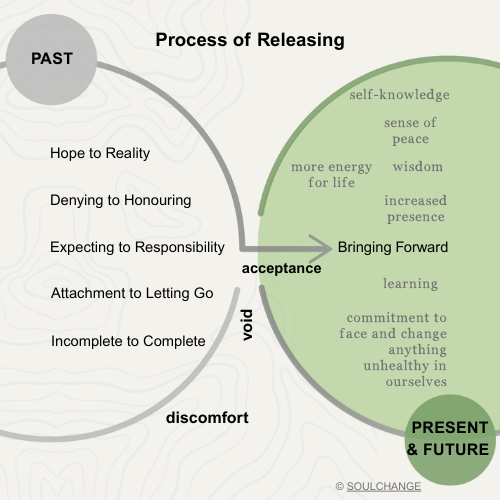
Even though releasing comes in all shapes and sizes, there is a bit of common process to it. Understanding the process can provide us with a roadmap that can help us navigate the terrain for ourselves. Appreciating that there are many ways to depict the process, here is one such depiction for you to consider.
Overall, through releasing we are moving ourselves from the past to the present and future.
The process typically occurs amid a landscape of some discomfort. The level of discomfort varies by person and significance of the release. The discomfort arises because of loss of control, loss of attachment, grief, uncertainty, anxiety, the sense of no longer having previously relied upon safety and security, feeling unsteady within ourselves, and not trusting life and the future, etc.
Through it all, we work to support ourselves and manage our discomfort. We notice it. We stay with it. We take breaks from it. We contain it as needed, and we return to it. All the while knowing that we are increasing our distress tolerance.
Release ultimately occurs with acceptance, but we usually get there through smaller, interrelated processes that come together into acceptance. (Not all aspects will apply to all releasing, especially smaller releases).
Overall, through releasing we are moving ourselves from the past to the present and future.
The process typically occurs amid a landscape of some discomfort. The level of discomfort varies by person and significance of the release. The discomfort arises because of loss of control, loss of attachment, grief, uncertainty, anxiety, the sense of no longer having previously relied upon safety and security, feeling unsteady within ourselves, and not trusting life and the future, etc.
Through it all, we work to support ourselves and manage our discomfort. We notice it. We stay with it. We take breaks from it. We contain it as needed, and we return to it. All the while knowing that we are increasing our distress tolerance.
Release ultimately occurs with acceptance, but we usually get there through smaller, interrelated processes that come together into acceptance. (Not all aspects will apply to all releasing, especially smaller releases).
We must move from hope to reality. At times, we can hold onto to hope in an almost toxic manner that does not serve us. It protects us from the pain of releasing, while keeping us stuck. So, we let go of false hope and come to see things clearly, about ourselves, the situation, others, circumstances, or whatever the case may be. We have to see it clearly, for what has happened, what it is, as well as what it wasn’t, or isn’t.
We have to move from denying to honouring. We need to figure out what we are denying about ourselves, others, the situation, what we hoped for. And then we need to honour that. We may need to acknowledge that we’ve been hurt and honour ourselves by feeling our pain. We may need to recognize that we are in fact the one who has hurt others. We may need to see our role in something that we were previously blaming others for.
We must move from expecting to self-responsibility. We have to let go of our expectations that others are going to be as we want them to be, that people who harm us will feel badly and make repair, that life will conform to what is just and right and will make us whole again. We needto accept self-responsibility to make it right and whole for ourselves, (with or without the involvement of others) and then set about doing so.
We must move from attachment to letting go. We often have more attachments than we realize. A lot of the pain we are feeling points us directly to our attachments. We have attachments to what we want things to be, to who we want people to be for us, to who we think we are, to the future we thought we would have or should have, to the outcomes we want, to the feelings we want to experience, and to the support we get from others in response to the pain we are experiencing. The list is near endless. We basically figure out why we are holding on to something, or someone, or a certain perspective of things and then find a way to let it go.
And we have to move from incomplete to complete. Obviously, things are not complete. If they were, we would have released things already. So, we find a way to bring completion for ourselves that preferably does not involve anyone else, unless they want to be involved. It’s up to us to find our own completion. We are essentially looking here to convert whatever is left of the stuck energy in some way, so it is no longer stuck. That might mean writing an unsent letter, saying a prayer of forgiveness, honouring a younger self that did not know better, or donating to a related cause.
Then from the place of acceptance, we bring forward our growth, healing, learning, newly understood qualities in ourselves, discernment, humility, wisdom, as well as our commitment to face and change anything that was not healthy in ourselves and take accountability.

Some Releases to Consider in the New Year (Or Any Other Time that Moves You)
Here are some suggestions for releases you might consider in varying sizes. Feel free to adapt them to suit yourself and the circumstances of your life. If you haven’t done a lot of releasing previously, it’s a good idea to start small and work your way up.
Smaller Releases
- Giving away unused clothing and/or household items.
- Letting go of the one who got away.
- Packing up and giving away projects that we are unlikely to get to.
- Forgiving ourselves for something small and unintended.
- Forgiving someone else for something small that happened.
Medium Releases
- Accepting that something we really wanted to work out, didn’t.
- Letting go of a dream or fantasy that we have been carrying.
- Letting go of something we had hoped to accomplish by this point in our lives.
- Forgiving ourselves for something medium whether intended or not.
- Forgiving some else for something medium sized that happened.
Larger Releases
- Bringing closure to a certain stage of our lives.
- Letting go of the way you have been putting blame for something onto someone else.
- Accepting the death of a significant relationship or a loved one.
- Forgiving ourselves for something significant, whether unintended or not.
- Forgiving someone else for something significant whether, unintended or not.
(Forgiveness, in short form, does not mean condoning what we, or someone else, has done, denying the pain, or the outcome. It is accepting, honouring, and making peace with what’s occurred and its impact and releasing ourselves from the burden of struggling against it and continually carrying it. It does not give up the importance of accountability but does allow us to move forward without it. It in no way requires us to maintain relationship with anyone who has caused us significant harm).
What one or two things are you releasing this winter?
Considering the reasons for resistance and the potential rewards, is there any doubt that releasing invites the rebel soul? Of course it does.
I encourage you to lean into winter and use the dark nights to free yourself from things you’ve been carrying for far too long.
Do it for yourself. Do it for your loved ones. Do it so that come spring, you have much more to bring into your life, and you’ll be more ready for whatever the restarting is.
In a few months, I’ll be picking up the seasons and the growth process with the 5 Rs of Restarting. In the meantime, please stay tuned for other posts.
With Humility, Hope, and Heart,