
Recovery from toxic stress and trauma is rarely a straight line, and it’s even less often a one-size-fits-all process. While we sometimes look for clear steps or fixed stages, the reality is that healing tends to unfold as an arc—one that shifts in pace, depth, and focus over time. There are moments of stabilization, moments of deeper processing, and moments of integration that don’t always follow a predictable order. What matters is not perfection or linear progress, but understanding the broader shape of what recovery can look like. A roadmap can be helpful, not as a rigid prescription, but as a way of orienting yourself within a complex and evolving process of change.
This post is part of a series: toxic stress and trauma.
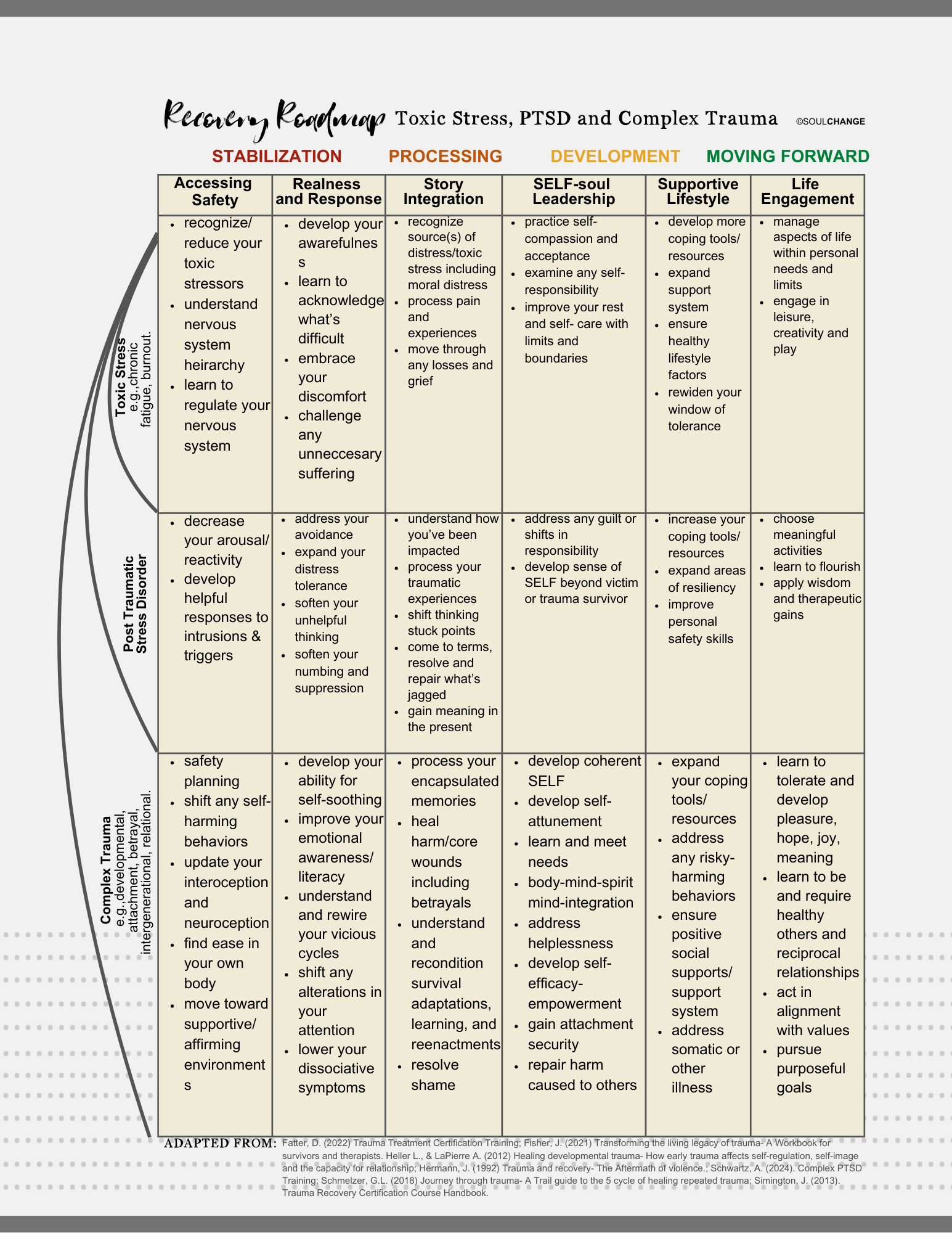
Recovery Roadmap
The hopeful reasons, including the breakthroughs in our understanding of toxic stress and trauma and recovery approaches, result in a bit of recovery roadmap. Like any other roadmap, it lays out the various phases of recovery (stabilization, processing, development, and moving forward) and shows the basic recovery tasks for toxic stress, compared to post traumatic stress disorder, compared to complex trauma.
Such a roadmap helps things be more concrete and seemingly manageable.

Finding a Recovery Analogy
Beyond such a roadmap, there are many different analogies for toxic stress and trauma and recovery. An onion, a bulb of garlic, a hook with many different size fish (traumas) on the line.
While these have appeal, I like to use the analogy of an ARC to think of toxic stress and trauma recovery because from my perspective it captures more of the nature and process of recovery.
If you’re not familiar, an analogy takes something a little complex, abstract and messy and gives it some concreteness. It often compares to something familiar that most people would recognize and often includes a visual. When understood, it can help us orient ourselves as we are going through something.
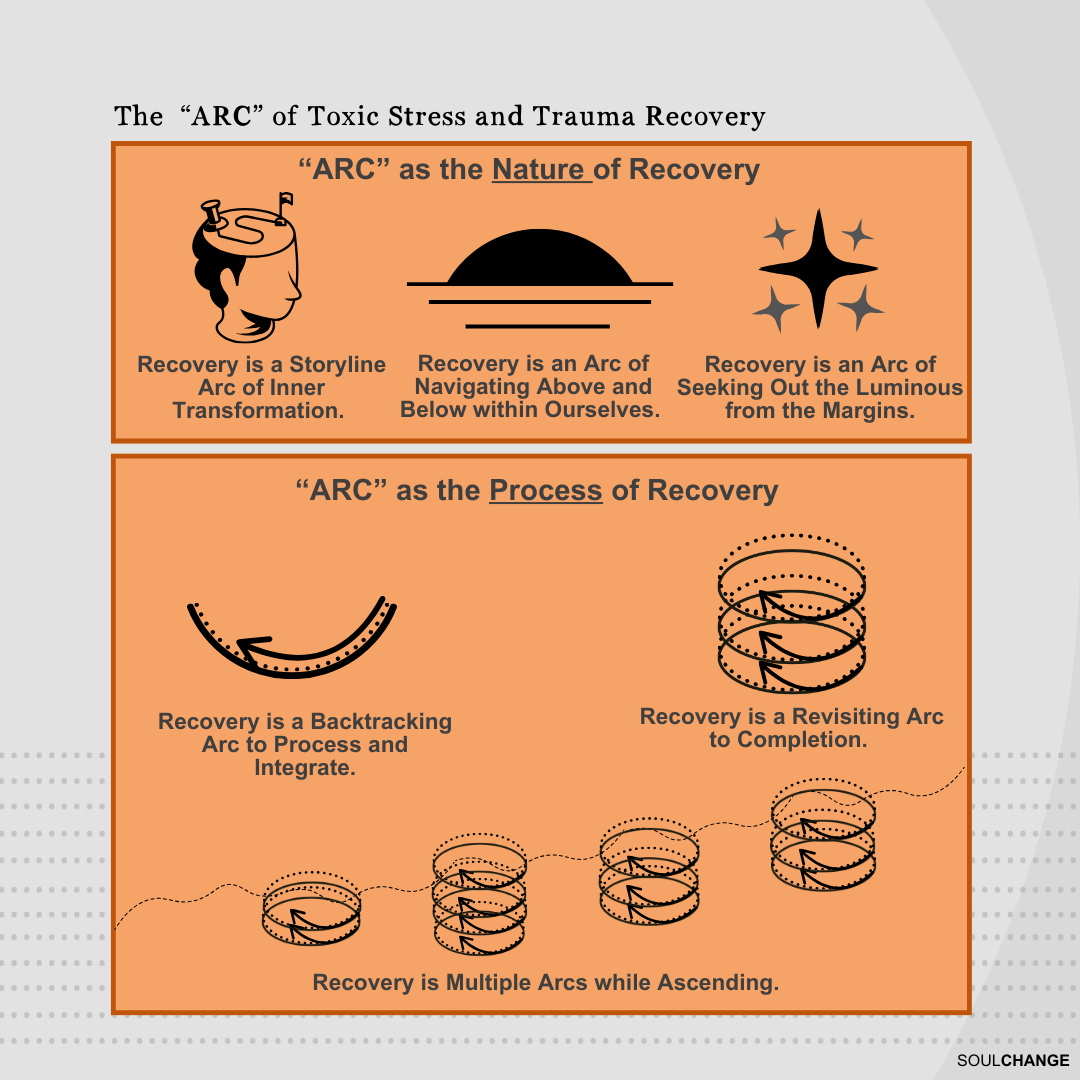
Arc as “Nature” of Recovery
An “Arc” represents the nature of recovery in three important ways.
Recovery is a Storyline Arc of Inner Transformation. An Arc, in writing, storytelling and movies, is the transformation or inner journey of a character over the course of a story and in response to changing developments in the story. Recovery is very much about the inner journey of healing, transformation, and revealing wholeness of the individual and the individual within their experiences (that of the hero and rebel soul). Recovery is their arc, but it also changes their arc or their storyline going forward.
Recovery is an Arc of Navigating Above and Below within Ourselves. An arc is also the apparent path described above and below the horizon by a celestial body such as the sun. Recovery involves navigating the path above and below within ourselves; the path of what is above and consciously known and the path of what is below and subconscious in our brains and bodies. As part of recovery, we must unearth what is subconscious so it can be transformed.
Recovery is an Arc of Seeking Out the Luminous from the Margins. An Arc is a luminous electrical discharge between two electrodes or points. Recovery is luminous, although not at first. It is a process of seeking out light (hope, healing, wholeness) from the margins and flickers below and beyond the horizon within ourselves and our lives. With increasing restoration and recovery, there is more radiating light that illuminates and transforms the dark.
Arc as “Process” of Recovery
An “Arc” also reflects the process of recovery in multiple ways.
Recovery is a Backtracking Arc to Process and Integrate. An Arc shows the core process for a recovery, which require backtracking through experiences of toxic stress and trauma in order to process and integrate them.
There are two general approaches to recovery. Which one is used depends on the practitioners training and expertise, the individual’s level of functioning, and whether trauma or complex trauma are involved.
One approach involves: Stabilization, Trauma Processing, and Integration. The thinking behind this approach is that stabilization needs to be attained in order to ensure that trauma processing does not de-stabilize the person further.
Stabilization involves working with the person and their nervous system. This involves addressing any need for safety planning, supporting someone to shift avoidant tendencies, become more attuned to their nervous system states, coming to recognize the types of things that affect it and trigger dysregulation, recognizing and working with triggers, and developing various skills and practices to maintain a more stabilized nervous system. Once a level of stabilization is maintained, attention is turned to processing the traumatic experiences.
The other approach goes straight to Trauma Processing and Integration while working to minimally stabilize the system, working on the understanding that resolving the underlying trauma will ultimately stabilize the system.
Trauma Processing involves titrated engagement with traumatic material. This means it is approached in an intentional and controlled manner while regulating the nervous system. The purpose is to integrate and resolve (or reconsolidate) the traumatic experience in the brain, in the self, in the storyline or narrative, and in their life.
There are lots of different approaches that use different combinations of right and left-brain and top (brain) down and bottom (body) up processing of toxic stress and traumatic material. Generally, they support individuals to:
- Decrease negative affect and sensorimotor reactions associated with trauma memories and recondition outdated adaptive reactions and ways of coping to healthful and helpful responses.
- Work with different aspects of self that were impacted and compassionately understand and shift their responses to the traumatic experience, including incongruence in their functioning compared with current reality.
- Recognize and shift internalized cognitive beliefs about self, others, and the world; and unhelpful thinking patterns and stuck points related to the toxic stress and traumatic memory/experience.
- Address shame, guilt, and shifts in responsibility.
- Emotionally process and come to terms with the full impact of traumatic experiences and their effect, including grieving the losses.
Once the traumatic experience is fully processed, it is held in a number of ways. The emotional and sensorimotor reactivity is decreased, whereby it is no longer experienced as “threat” in the nervous system. There is development of a personal understanding of the traumatic experience within one’s life that is coherent and can be put into words and integrated with a logical sequence of feelings, thoughts, and action. The individual gains an understanding of relational motives and actions of others involved, such as those who harmed, other victims, caregivers who helped or didn’t protect, bystanders, and community response, as well as how this impacted one’s experience. Meaning making or one’s relationship to the traumatic event or experience usually changes with new insight and wisdom. There is an increase in one’s sense of Self and one’s efficacy.
Integration is like pulling the thread of the processed trauma through the rest of one’s SELF and one’s life. It is usually a much shorter part of recovery and typically involves a number of things such as: applying therapeutic gains to daily life and future; developing a sense of self beyond a victim or trauma survivor; increasing comfort in one’s body; exploring pleasure, hope, and joy; improving personality integration, personal safety skills, assertiveness, meeting needs, quality of relationships, and connection with trustworthy others.
Recovery is Revisiting Arcs to Completion. When toxic stress or trauma are complex, they have many toxic and traumatic experiences involved and have a widespread effect within the system.
For example, for someone who was abused or neglected, those are not typically single incident traumas. They are recurring traumas with many specific traumatic incidents, but also ongoing caregiver patterns and household dynamics involved.
So, recovery often moves through a revisited arc, whereby each pass processes more of the trauma until it is fully resolved and integrated.
Recovery is Multiple Arcs While Ascending. When trauma is complex, recovery is also understandably complex. It involves many revisiting arcs. There may be a revisiting arc to address avoidance, and one to deal with triggers. There may be a revisiting arc for abuse, another for neglect, and one for bullying at school. There may be a revisiting arc for self-worth, and another for abandonment of self. There may be a revisiting arc to develop attachment security and deal with present day relationships, and another one to clean up the survival elements that are impacting one’s parenting.
While the notion of recovery involving so many revisiting arcs can be overwhelming, it can help to remember two things. Each arc is easier to navigate than the last because we understand the process of recovery and our starting point for recovery involves all of the gains from the previous round: the increased SELF, the skills, the insight and learning, and the post-traumatic growth. So, we move through it faster and easier. And, following each arc of recovery, our overall functioning is more stable, healthy, and conscious, so our lives ascend. Through time we scaffold our way up and rise out of survival, and begin to experience what it is to strive and thrive.
If you’re in the midst of a painful or profound winter as a result of toxic stress or trauma, hopefully this recovery roadmap and the analogy of recovery being like an ARC is helpful to you. May they both help you orient yourself along the path and help you feel like you’ve not only got this but that the difficult journey is meaningful to your life and the world.
With Humility, Hope, and Heart,