

What if the voice you’ve spent your whole life trying to silence is the very thing meant to lead you to conscious relating and creating? Beneath the noise of expectations, fear, performance, conditioning, and survival lives another voice—steady, wise, untamed, and deeply honest.
The voice of the rebel soul does not shout to dominate; it speaks to awaken. It is the part of you that recognizes when a life looks acceptable on the outside but feels abandoned on the inside. Learning to hear that voice is not simple. It competes with inherited beliefs, cultural programming, ego, trauma, self-doubt, and the endless demand to conform. This post explores why the voice of the rebel soul matters so profoundly, how to distinguish it from the many other internal voices that mimic truth, how to build a real relationship with it, and how to recognize its unmistakable tone.
Related Posts: This is part of a series about the REBEL SOUL. Click here for clarification on what I mean by SOUL.
The Voice of the Rebel Soul
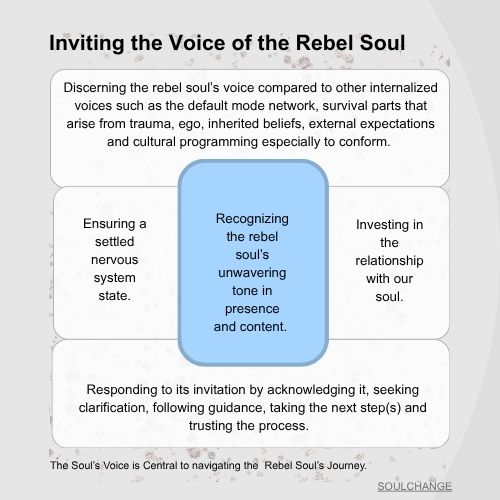
- Is critically important in navigating every aspect of the rebel soul’s journey.
- Can be encouraged by:
- Ensuring a settled nervous system state.
- Investing in the relationship with our soul.
- Discerning the voice compared to other internalized voices such as survival parts that arise from trauma, ego, inherited beliefs, external expectations, and cultural programming, especially to conform.
- Recognizing its unwavering tone in presence and content.
- Responding to its invitation.
The Rebel Soul’s Voice is Central to the Journey
At its core, the rebel soul’s journey is about moving closer and closer to conscious relating and creating by moving along one or more of the 12 pathways of becoming better selves, creating better lives, and contributing to a better world.
The soul’s voice, deep within, provides us with:
- A foundational imprint of conscious relating and creating and the dimensions of connectedness, empowerment, wonder, growth, cooperativeness, responsiveness, knowingness, and wholeness that we can attune to.
- An uncomfortable sense of misalignment when there is an absence of or lesser degree of conscious relating and creating, whether in ourselves, our lives, or the world.
- The call to respond.
- A higher perspective whenever we seek it.
- A sort of companionship as we turn tensions into transformation.
- Encouragement to stay strong and committed even in the face of uncertainty, difficulties, and consequences we did not anticipate.
- Intuitive guidance along the way.
- A sense of contentment, in celebration or consolation, no matter how things turn out.
- Ongoing support throughout the larger journey of our own conscious evolution.

Ensuring a Regulated Nervous System State
It may seem unrelated, but the state of our nervous system is actually a prerequisite for hearing the voice of the rebel soul. Here me out, even though this is a limited overview of stress, states, and the nervous system.
The nervous system includes the brain, spinal cord, and a complex network of nerves throughout the body. Its main function is to send messages from various parts of the body to the brain and from the brain back out to the body to tell the body what to do. It is the command centre and is key to all aspects of our functioning and survival. It regulates everything from our thoughts, memory, learning and feelings to our movements, sensations, and body processes like breathing, blushing, and blinking.
According to Dr. Stephen Porges’s Polyvagal Theory, the three nervous system circuits combine in different variations to form six main nervous system STATES. Stress appraisal of safety, lack of safety, challenge, demand, threat, or danger, and the degree of stress activation determine which STATE is enlisted to ensure safety and well-being.
In order to be in a connected state to ourselves and the presence and voice of our soul, we need to be in one of the regulated FLOCK states (vagal brake turned on). So essentially, inside our window of tolerance and not experiencing so much stress activation that our nervous system shifts into one of the survival defense states (fight or flight, freeze or fawn, flop).
Our STATE affects all of the following. When we are in a flock state of connection these things function well, but they are all compromised when we are in one of the survival defenses:
- our cognitive ability, especially higher-level thinking.
- our self-awareness, sense of self, self-talk, and overall mood.
- our perspective about ourselves, others, circumstances, and the larger world.
- our motivation, and the ability to delay gratification, motivate ourselves, be disciplined, and work toward our goals.
- our ability to create, adapt, learn new things, and shift from mistakes.
- our ability to live from values, be in integrity, and take accountability.
- our ability to connect with and create meaning.
- the states of those around us as others continuously, automatically, and subconsciously pick up on our STATE (and cues about our STATE) as being safe or unsafe.
- our ability to recognize and receive intuition and guidance.
- our ability to connect with and relate to others.
- our self-care, coping, and lifestyle behaviors (restful sleep, nutrition, risky behaviors}.
- overall energy levels, health, and well-being.
So, in order to be connected to ourselves and soul and to have the best chance of discerning other thoughts and voices and recognizing the voice of soul, we need to ensure we are in a settled social state. We can do this by keeping the stress levels in our lives manageable and using practices for settling ourselves.
Keeping ourselves settled is like opening the gateway to accessing soul. If we’re in survival, it doesn’t mean the soul isn’t accessible or communicating with us. It is. But our ability to discern it, recognize it, and interpret it accurately is compromised.
(If you want to understand more about the nervous system or want some settling practices, check out the giveaways).
Investing in a Relationship with Our Soul
We can also encourage the voice of our rebel soul by investing in our relationship with our soul. This doesn’t need to be grandiose. It can quiet, consistent and simple. All we need do is acknowledge our soul and do things that feed our soul regularly, e.g., walk in nature, play with art, listen to inspiring music, read spiritual material, or perhaps pray.

Discerning Compared to Competing Voices with Our Soul
Whether we recognize it or not, we have many internal thoughts that can seem like different voices.
Those different thoughts can be so consistent and compelling that they don’t allow much space to recognize, hear, or turn into the voice of soul, or we unknowingly mistake them to be the voice of the rebel soul.
While the rebel soul is certainly an important voice, it is not competitive in nature and doesn’t typically work to drown out other thoughts and voices, (although it finds ways to get our attention). Therefore, the onus is on us to understand and learn to differentiate the types of thoughts and quiet those that aren’t the soul.
The most common competing voices include:
Default Mode Network (DMN) is a large-scale brain network that is the brain “background system”. It becomes highly active with self-referencing thoughts, mind-wandering, day dreaming, social cognition, and memory retrieval during quiet wakefulness when we are not actively focused on externally demanding tasks.
DMN thoughts most often take the form of:
- Mental time travel related to personal history and future goals or wishes.
- Thinking about and processing social interactions such as running back through an interaction, trying to understand the perspectives of others, or rehearsing how to handle something.
- Self Narrative in reflecting on, evaluating, and making meaning about oneself.
When the DMN is overactive, it can lead to problematic thinking and ruminating or looping.
Healthy Ego Influenced by Toxic External Messages A healthy ego (self worth without needing constant external validation, with realistic balanced self-perception, admission of mistakes and taking responsibility, motivating ourselves toward goals, resilience, adaptability, and balanced needs of self and others) allows for growth, development, and evolution, so is likely to allow for the voice of the rebel soul.
Where this can become complicated is when we are influenced by larger toxic external messages and expectations that disregard, distort, or dictate the terms of our inherent worth and our place in the world relative to others. There are countless ways this shows up in messages that our worth/acceptance/belonging is based on perfection and not having any ‘problems’, achievement, performance, or status, attaining wealth, suppressing our feelings or concerns, meeting certain physical characteristics and beauty ideals, conforming to gender, sexuality, and relationship norms, accepting diminished relative status, not questioning rules and authority, and otherwise adhering to the status quo.
These toxic external messages create internal fear and a focus on attainment while staying within the parameters of the externally dictated conditions. These things leaves limited room for the authentic voice of soul and often broadcast loudly enough that we may mistake them as our soul.
Insecure Toxic Ego tends to be self-centred, validation seeking, avoidant of personal responsibility, lacking empathy, and defensive either through inflating (arrogance, entitlement, superiority, self-promoting, exploitiveness, diminishing others), or fragility (feeling sorry for self, high sensitivity, expecting to be taken care of, diminishing self often to gain support of others).
Such an insecure ego takes up a lot of space in the self, leaving limited or no room for the voice of soul and doesn’t have enough internal security to attune with the soul.
Survival Adaptations or Parts develop in response to difficult and prolonged circumstances, particularly complex trauma, in an effort to ensure survival. They often form as deeply rooted subconscious core beliefs and behavior patterns that can impact such things as self-concept, attachment styles and reenactment, self-efficacy, stability and resilience, and a sense of hopefulness.
These thoughts can be quite easily mistaken as coming from soul because they are strong from being intwined with unprocessed traumatic circumstances and relationships and they are situated in the subconscious and limbic (emotional) brain, so they feel like they are coming from deep within.
Recognizing the Soul’s Unwavering Tone
Even more important than learning to determine competing thoughts and voices is being able to recognize the unwavering tone of the soul. Like most things soul related, this is not an area of absolute knowledge in the quantitative scientific sense. There is no test to measure for the soul’s voice. Rather, it is based on spiritual teachings and the qualitative research of people’s self-reported experience that can be found in the literature.
There are two things (presence and content) we can pay attention to as we are recognizing the rebel soul’s unwavering tone.
Presence, is the energy, the feeling, and the quality of the engagement. Soul’s presence* is:
- Connecting and interconnecting while discerning how things relate and connect to one another, including wholeness and integrating all aspects of self.
- Expansiveness, unboundedness, and transcending what is time, space, and circumstances.
- Meaning giving and being gripped with ultimate concern.
- Wise and righteous with ethics and morality.
- A source of peace, love, hope, inspiration, and strength.
- Ever present, even if the psyche and body are not aware of such.
- Providing guidance through interruption, aha! moments, warnings, insight and ideas, symbols, and symbolic meaning, which can result in use of imagery and dreams.
Content is the kinds of things that the soul is voicing to us and through us. The Soul’s content consistently encourages and supports connectedness, empowerment of self and others, wonder, growth, cooperativeness, responsiveness, knowingness, and wholeness, as well as one or more of the rebel soul pathways of becoming better selves, creating better lives, and contributing to a better world. The content is also pure or profound, even when simplified. It is also gentle, loving, honest, real, and humanitarian. It stretches us and encourages our accountability.
All too often, we can have an ego-based expectation (or entitlement) that the rebel soul’s content is going to lead to ease, love, health, and wealth, and it may some of the time. But that isn’t its purpose. Its purpose is to grow and develop us and ignite us in transformation that increases conscious relating and creating within us, our lives, and our world. It’s often very uncomfortable to be fortified. Some of its content will absolutely bring ease and help us take better care of ourselves, but most of it is going to pull us further along the path of evolution which can be quite uncomfortable.
The Soul content* provides:
- Support, strength, comfort, love, inspiration, discernment, compassion, and mercy, that often results in a sense of connectedness, gratefulness, universality, nonjudgement, and/or existentiality.
- Encouragement to move toward, lean into, and engage with joy, delight, play, celebration, imagination, gratitude, wonder, awe when encountering power, grace, brilliance, love, and the mystery of life or the sheer joy of being alive.
- Infusions of inspiration through largely unconscious and symbolic processes that is brought into physical form to expand one’s creative potential e.g., developing a new idea, a work of art, a scientific discovery, or an entirely new lens on life.
- Insight into ultimate reality, which may include the afterlife, as well as a search for that reality, how the physical world should be implicitly or explicitly perceived, and adherence to certain values.
- Support regarding the quest for significance as a way of being in life relative to meaning through finding hopefulness and answers to ultimate questions; making sense of things such as the cyclical processes of life, life on earth, and determining one’s embodiment versus renunciation of worldly needs and experiences; one’s relationships to the sacred or the transcendent, understanding and holding paradoxes, and confronting the mysteries and tragedies of life.
- Help to stand outside of one’s immediate sense of time, place, and experience to view life from a much larger, objective and spiritual perspective which leads to a natural extension beyond the conscious self into the regions of the unconscious or absolute self, which results in a greater awareness of the gifts one’s life has bestowed, liberation from suffering, opening to life and death, and movement well beyond material goods and possessions for fulfilment.
- Encouragement to engage in introspection, self-reflection, facing fears, letting go of ego, dealing with the unknown, and re-definition and release from self-defined limitations, as well as drawing on inner strengths. The result is becoming more self-aware, self-surrendering, authentic, loving, and enlightened whereby one can reach a state of Being where one is consciously aware and responding to situations, events, people, and environments from one’s philosophy of life and values with integrity and inner strength.
- Pull toward healing wounded or painful parts, integrating all aspects into a coherent self, and becoming increasingly whole in one’s being.
- Support to detach so that we can find peace or centredness, see each day as a gift, and feel good about the unfolding and direction of life even in the midst of difficulty.
- Moral and ethical pushes for developing virtues such as honesty, commitment, courage, compassion, forgiveness, and nonjudgemental acceptance while requiring that those virtues are observed and practiced during one’s real life, relationships, and circumstances even in the midst of competing motivations.
- Encouragement to overcome negativity and judgment toward an offender (including oneself) and allow for the path of redemption not by denying the right to such feelings, but by endeavoring to view the offender with compassion, benevolence, and love while recognizing that they have abandoned the right to receive them.
- Suggestions for externally manifesting spiritual beliefs and inner spiritual state through contemplation, external practices, and rituals, etc.
- Assistance in discovering and bringing to life one’s sense of mission, purpose, or ‘vocation’, and in engaging in a journey of becoming who one needs to become to fulfill it.
- Awareness of oneness and a sense of the unifying interconnectedness of humanity which translates into a longing for deep connection in relationships, believing in the goodness of all people and accepting others as they are, and having a high degree of care, concern, and compassion about the welfare of others while recognizing the tragic realities of human existence, pain, suffering, and death.
- Direction to engage in altruistic actions that result in a discernable effect upon the larger social and physical world that involves giving the gift of self to these things. It can involve engagement in many ways and many levels, e.g., attending deeply with compassion toward others, helping friends with personal problems, participating in community service, donating money to charity, philanthropy, cultivating sacred environments, expressing concern for social causes, idealism and courage to work towards what ought to be in society, rather than accepting what is; questioning and challenging injustice, and social transformation.
Responding to the Voice of Soul
And finally, we can encourage the voice of soul by responding. The more we respond, the stronger and clearer the voice will seem, the more faith we will develop in where it’s leading us, and the more resolved we will become in moving into living from a place that is soul centred and authored.
This means acknowledging what we’re hearing, asking for clarification if we’re truly confused, showing gratitude for the assistance and then following through on the guidance.
It also means not expecting or asking for assurances or specific outcomes for following through. It’s not a negotiation to keep us safe and secure. It’s a continual process of tension and transformation to increase conscious relating and creating in ourselves, our lives, and in the world through big and small rebellions.
Why Hearing the Voice of the Soul Matters
The voice the soul reflects is our compass and provides mentorship and guidance, so being able to effectively hear and respond to its voice is central to our journey.
It broadcasts the foundational imprint of conscious relating and creating.
It allows us to sense and become motivated by misalignment.
It supports us to turn tensions into transformation and evolves us.
It comes alongside as we move through the process of transformation again and again along the pathways of becoming better selves, creating better lives, and contributing to a better world.
Takeaways About the Revolutionary Voice of Soul
- Hearing the voice of the SOUL is central to the journey of conscious relating and creating, so it’s important to work on hearing it effectively.
- Survival nervous system states compromise our ability to connect to ourselves and the voice of the soul within, so ensuring we are in settled nervous system states is a sort of prerequisite.
- Doing small consistent things that support a relationship with our rebel soul encourages communication.
- Learning to discern the many other internalized voices (DMN, survival parts, ego) and recognize the unwavering tone of the rebel soul is essential to hearing its voice.
- Responding to invitations of the soul, especially into the process of rebellion, by acknowledging them and following through strengthens our sense of the soul’s voice with practice.
Remembering the Voice of the Rebel Soul
We’re all at different places in effectively hearing the voice of our soul that depend on so many things. And that’s okay.
Ironically, I think we all start off hearing the voice of our soul perfectly and through the course of life and circumstances, we unintentionally develop barriers and sort of unlearn it. So, it’s not so much developing new skills as it is softening the barriers, remembering the soul’s voice and turning toward it.
With Humility, Hope, and Heart,

*The listings about the soul’s presence and content were condensed from comprehensive literature reviews (conducted 2005 and 2024) that pulled together the qualitative studies of dozens and dozens of researchers.
Anandarajah, G. & Hight, E. (2001). Spirituality and medical practice: Using the HOPE questions as a practical tool for spiritual assessment. American Family Physician, 63, 1, 81-89.
Astin, A., Astin, H., & Lindholm, J. (2011). Cultivating the spirit: How colleges can enhance students’ inner lives. San Francisco: Jossey-Bass.
Barber, C. (2019). Working within a spiritual framework. British Journal of Nursing, 28, 229.
Barrett, M.C. (2016). Dimensions of spirituality fostered through the PULSE program for service learning. Journal of Catholic Education, 20,1, 114-135.
Borba, M. (2001). Building Moral Intelligence- The Seven Essential Virtues that Teach Kids To Do the Right Thing. San Fransisco: Jossey-Bass.
Bregman, L. (2014). The Ecology of spirituality: Meanings, virtues, and practices in a post-religious age. TX: Baylor University Press.
Burkhardt, M.A. (1993). Characteristics of spirituality in the lives of women in a rural Appalachian community. Journal of Transcultural Nursing, 4, 2, 2-18.
Burkhardt. M.A. (1994). Becoming and connecting elements of spirituality for women. Holistic Nursing Practice, 8, 12-21.
Burkhardt, L., & Hogan, N. (2008). An experiential theory of spiritual care in nursing practice. Qualitative Health Research, 18, 928-938.
Carson, V. (1989). Spiritual development across the lifespan. In V. Carson (Ed.), Spiritual Dimensions of Nursing Practice (p. 24-51). Philadelphia: Saunders.
Chandler, C.K., Miner-Holden, J., & Kolander, C.A. (1992). Counseling for spiritual wellness: Theory and practice. Journal of Counseling & Development, 71, 2, 168-175.
Chiu, L., Emblen, J. D., Van Hofwegen, L., Sawatzky, R., & Meyerhoff, H. (2004). An integrative review of the concept of spirituality in the health sciences. Western Journal of Nursing Research, 26, 405–428.
Cook, C. H. (2004). Addiction and spirituality. Addiction, 99, 539-551.
Coward, D.D. (1991). Self-transcendence and Emotional well-being in women with advanced breast cancer. Oncology Nursing Forum, 18, 857-863.
Creel, E. & Tillman, K. (2008). The meaning of spirituality among nonreligious persons with chronic illness. Holistic Nursing Practice, 22, 303-309.
DeHoff, S. L. & Massey, J. D. (2022). Spirit as a separate dimension of human nature: Relevance to psychotherapy. Pastoral Psychology, 71, 511-524.
Dhar, N., Chaturvedi, S.K. & Nandan, D. (2011). Spiritual health scale 2011: Defining and measuring the 4th dimension of health. Journal of Community Medicine, 36, 4, 275-282.
Emblen, J. (1992). Religion and spirituality defined according to current use in the nursing literature. Journal of Professional Nursing, 8, 41-47.
Estanek, S. M. (2006). Redefining spirituality: A new discourse. College Student Journal, 40, 2, 270–281.
Fahlberg, L.L. & Fahlberg, L.A. (1991). Exploring spirituality and consciousness with an expanded science: Beyond the ego with empiricism, phenomenology and contemplation. American Journal of Health Promotion, 5, 4, 273-281.
Fenwick, T.J. & English, L.M. (2004). Dimensions of spirituality: A Framework for adult educators. Journal of Adult Theological Education 1,1, 49-64.
Fetzer Institute/National Institute on Aging Working Group. (1999). Multidimensional measurement of religiousness/spirituality for use in health research. Kalamazoo, MI: Fetzer Institute.
Florczak, K. L. (2010). Gathering information on spirituality: From whose perspective? Nursing Science Quarterly, 23, 201-205.
Foley, L. (2000). Exploring the experiences of spirituality in older women finding meaning in life. Journal of Religious Gerontology, 12, 1, 5-15.
Fowler, J. (2017). From staff nurse to nurse consultant: Spiritual care part 1: The importance of spiritual care. British Journal of Nursing, 26, 478.
Friedman, H., Krippner, S., Riebel, L. & Johnson, C. (2010). Transpersonal and other models of spiritual development. International Journal of Transpersonal Studies, 29, 1, 79-94.
Fry, P.S. (2000). Religious involvement, spirituality and personal meaning for life: Existential predictors of psychological well-being in community-residing and institutional care elders. Aging & Mental Health, 4, 4, 375-387.
Fry, P.S. (2001). The Unique contribution of key existential factors to the prediction of psychological well-being of older adults with spousal loss. Gerontologist, 4, 1, 69-81.
Gall, T. L., Mallette, J., Guirguis-Younger, M. (2011). Spirituality and religiousness: A Diversity of definitions. Journal of Spirituality in Mental Health, 13, 158-181.
Gardner, F. (2011) Critical Spirituality: A Holistic approach to contemporary practice. Ashgate, Farnham (Surrey).
Gottlieb, R.S. (2013). Spirituality- What is it and why it matters. NY: Oxford University Press.
Haber, J. R., Jaco, T. & Spangler, D.J. (2007). Dimensions of religion/spirituality and relevance to health research. The International Journal Psychology of Religion, 7, 4, 265-288.
Hardy, S. A., Nelson, J. M., Moore, J.P., & Ebstyne-King, P. (2019). Processes of religious and spiritual influence in adolescence: A systematic review of 30 years of research. Journal of Research on Adolescence 29, 2, 254–75.
Harris, K. A., Howell, D. S., & Spurgeon, D. W. (2018). Faith concepts in psychology: Three 30-year definitional content analyses. Psychology of Religion and Spirituality, 10, 1–29.
Hiatt J.F. (1986). Spirituality, medicine and healing. Southern Medical Journal, 79, 6, 736-743.
Hill, P.C. (2005). Measurement in the psychology of religion and spirituality: Current status and evaluation. In R.F. Paloutzian, & C.L. Park (Eds.) Handbook of the psychology of religion and spirituality (p. 43–61). NY: Guilford
Hill, P. C., Pargament, K.I., Hood, R.W., McCoullough, M.E., Swyers, J.P., Larson, D.N. &
Huitt, W. & Robbins, J. (2018). Spiritual development: Meaning and purpose. In W. Huitt (Ed.), Becoming a Brilliant Star: Twelve core ideas supporting holistic education (p. 159-178). TN: Ingram Spark. Retrieved from http://www.edpsycinteractive.org/papers/2018-09-huitt-robbinsbrilliant-star-spiritual.pdf (Kessler, 2000 The Soul of Education: Helping students find connection, compassion, and character in school.)
Hyman, C. & Handal, P. J. (2006). Definitions and evaluation of religion and spirituality items by religious professionals: A Pilot study. Journal of Religion and Health, 45, 2, 264-282.
Johnson, T.J., Sheets, V.L. & Kristellar, J.L. (2008). Empirical identifi1cation of dimensions of religiousness and spirituality. Mental Health, Religion & Culture, 11, 8, 745-767.
Johnston, D. & Mayers, C. (2005) Spirituality; a review of how occupational therapists acknowledge, assess, and meet spiritual needs. British Journal of Occupational Therapy 68, 9, 386-392.
Kendler, K. S., Liu, X.-Q., Gardner, C. O., McCullough, M. E., Larson, D., & Prescott, C. A. (2003). Dimensions of religiosity and their relationship to lifetime psychiatric and substance use disorders. American Journal of Psychiatry, 160, 496–503.
King M., Speck P., & Thomas A. (1999). The Effect of spiritual beliefs on outcome of illness. Social Science & Medicine, 48, 9, 1291-1299.
Labun, E. (1988). Spiritual care: An element in nursing care planning. Journal of Advanced Nursing, 13, 3, 314-320.
LaPierre, L.L. (1994). A model for describing spirituality. Journal of Religion and Health, 33, 153-161.
Lauver, D.R. (2000). Commonalities in women’s spirituality and women’s health. Advances in Nursing Science, 22, 3, 76-88.
Lavorato Neto, G., Rodrigues, L., Rozendo da Silva, D. A., Ribeiro Turato, E., & Gomes Campos, C. J. (2018). Spirituality review on mental health and psychiatric nursing. Revista Brasileira de Enfermagem, 71, 2323-2333.
Lewis, L.M., Hankins, S., Reynolds, D. & Ogedegbe, G. (2007). African American spirituality. A Process of honouring god, others and self. Journal of Holistic Nursing, 25, 1, 16-23.
Loiseau, C.C. (2005). On the beam: Exploring the relationship between spirituality and health. Master’s Thesis, Faculty of Graduate Studies, University of Alberta.
Love, P., & Talbot, D. (2009). Defining spiritual development: A missing consideration for student affairs. NASPA Journal, 46, 4, 614-628.
MacKinlay, E. (2006) Spiritual growth and care in the fourth age of life. UK: Jessica Kingsley Publishers.
Maslow, A. H. (1970). Religions, values, and peak experiences. NY: Viking.
Mata-McMahon, J., Haslip, M.J. & Schein, D.L. (2020). Connections, virtues and meaning- making: How early childhood educators describe children’s spirituality. Early Childhood Education Journal, 48, 657-669.
Mattes, R. (2005). Spiritual need one: Spiritual development: The Aging process: A Journey of lifelong spiritual formation. Journal of Religion, Spirituality & Aging, 17, 3, 55-72.
Maurya, R.K., Jain, S. Grey, B. & Clarfield, J. (2022). Evolution and process of spiritual awakening: A grounded theory study. Counselling and Psychotherapy Research, 23, 906-918.
Mayhew, M. J. (2004). Exploring the essence of spirituality: A phenomenological study of eight students with eight different worldviews. NASPA Journal, 41, 3, 647–674.
McClinkock, C.H., Lau, E. & Miller, L. (2016). Phenotypic dimensions of spirituality: Implications for mental health in China, India and the United States. Frontiers in Psychology, 7, article 1600.
McSherry, W., & Cash, K. (2004). The language of spirituality: An emerging taxonomy. International Journal of Nursing Studies, 41, 151–161.
Meraviglia, M.G. (1999). Critical analysis of spirituality: Its empirical indicators. Journal of Holistic Nursing. 17, 1, 18-23.
Moore, T. (2002). The Soul’s religion: Cultivating a profoundly spiritual way of life. NY: Harper Collins.
Myss, C. & Joseph, S. (2012). Your creative soul: Expressing your authentic voice. CO: Sounds True.
Myss, C. & Harvey, A. (2014). Divine rebels: Saints, mystics, holy change agents and you. CO: Sounds True.
Neff, J.A. (2006). Exploring the dimensionality of ‘‘religiosity’’ and ‘‘spirituality’’ in the Fetzer multidimensional measure. Journal for the Scientific Study of Religion, 45, 449–459.
Oldnall, A. (1996). A Critical analysis of nursing: Meeting the spiritual needs of patients. Journal of Advanced Nursing, 23, 1, 138-144.
Painadath, S. (2005). Mysticism, the depth-dimension of spirituality. Journal of Dharma, 30, 4, 359-409.
Pargament, K.I. & Exline, J.J. (2022). Working with spiritual struggles in psychotherapy. From research to practice. NY: Guilford Press.
Peterson, C. & Seligman, M. (2004). Character strengths and virtues. A handbook and classification. NY: Oxford University Press.
Piedmont, R. L. (1999). Does spirituality represent the sixth factor of personality? Spiritual transcendence and the five-factor model. Journal of Personality 67, 6, 985–1013.
Popov, D., Kavellin Popov, L. & Kavellin J. (2007). Virtues Project. Awaken the virtues within. Presentation at ACSW Annual Conference.
Reed, P. (1992). An emerging paradigm for the investigation of spirituality in nursing. Research in Nursing & Health. 15, 5, 349-57
Rockenbach, A.N., Mayhew, M.J., Davidson, J., Ofstein, J. & Clark Bush, R. (2015). Complicating universal definitions: How students of diverse worldviews make meaning of spirituality. Journal of Student Affairs Research and Practice. 52, 1, 1-10.
Santos, C. & Michaels, J.L. (2022). What are the core features and dimensions of “spirituality”? Applying partial prototype analysis to understand how laypeople mentally represent spirituality as a concept. Psychology of Religion and Spirituality, 14, 1, 10-20.
Scandurra, A.J. (1999). Everyday spirituality: A Core unit in health education and lifetime wellness. Journal of Health Education, 30, 2, 104-109.
Senreich, E. (2013). An Inclusive definition of spirituality for social work education and practice. Journal of Social Work Education, 49, 548-563.
Seong-Hyeon, K., Lee, N. & Ebstyne King, P. (2020). Dimensions of religion and spirituality: A Longitudinal topic modeling approach. Journal for the Scientific Study of Religion, 59, 1, 62-83.
Sharp, C.A. & Johnson, K.A. (2020). Assessing spirituality on two dimensions: Closeness to god and focal orientation. International Journal for the Psychology of Religion, 30, 1, 48-67.
Sheldrake, P. (2012). Spirituality: A very short introduction. Oxford University Press.
Sheldrake, P. (2016). Constructing spirituality: The “politics” of definitions and historical interpretations. Religion & Theology, 23, 15-34.
Shorkey, C., Uebel, M. & Windsor, C. (2008). Measuring dimensions of spirituality in chemical dependence treatment and recovery: Research and practice. International Journal of Mental Health Addiction, 6, 286-305.
Spilka, B. (1993). Spirituality: Problems and directions in operationalizing a fuzzy concept. Paper presented at the annual convention of the American Psychological Association, Toronto, Ontario.
Stewart, C., & Koeske, G.F. (2006). A preliminary construct validation of the multidimensional measurement of religiousness/spirituality instrument: A study of southern USA samples. The International Journal for the Psychology of Religion, 16, 181–196.
Stoll, R. (1989). The Essence of Spirituality. In V. Carson (Ed.), Spiritual Dimensions of Nursing Practice (p. 4-23). Philadelphia: Saunders.
Sullivan, W.P. (1993). It helps me to be a whole person: The Role of spirituality among the mentally challenged. Psychosocial Rehabilitation Journal, 16, 3, 125-134.
Tanyi, R. (2002). Towards clarification of the meaning of spirituality. Journal of Advanced Nursing 39,5, 500-9
Taylor, S. (2012a). Spontaneous awakening experiences: Beyond religion and spiritual practice. Journal of Transpersonal Psychology, 44, 1, 73–91.
Taylor, S. (2012b). Transformation through suffering: A study of individuals who have experienced positive psychological transformation following periods of intense turmoil. Journal of Humanistic Psychology, 52, 1, 30–52.
Taylor, S. (2017). The leap: The psychology of spiritual awakening. New World Library.
Taylor, S. (2018). Two modes of sudden spiritual awakening? Ego-dissolution and explosive energetic awakening. International Journal of Transpersonal Studies, 37, 2, 131–143.
Taylor, S., & Egeto-Szabo, K. (2017). Exploring awakening experiences: A study of awakening experiences in terms of their triggers, characteristics, duration and after-effects. The Journal of Transpersonal Psychology, 49, 1, 45–65.
Tisdell, E.J. (2003). Exploring spirituality and culture in adult and higher education. San Francisco: Josey Bass.
Thoreson, C.E. (1999). Spirituality and health: Is there a relationship? Journal of Health Psychology, 4, 3, 291-300.
Tomlinson, J., Glenn, E.S., Raine, D.R & Sandage, S.J. (2016). What is the “relational” in relationship spirituality? A Review of definitions and research directions. Journal of Spirituality in Mental Health, 18, 1, 55-57.
Townsend, E. (1997). Inclusiveness: A Community dimension of spirituality. Canadian Journal of Occupational Therapy, 64, 1, 146-155.
Unruh, A., Versnel, J. & Kerr, N. (2002). Spirituality unplugged; a review of commonalities and contentions, and a resolution. Canadian Journal of Occupational Therapy 69, 1, 5-19.
VIA Institute on Character. (2019). Spirituality. Retrieved from https://www.viacharacter.org/character-strengths/spirituality.
Villegas, D.L. (2018). Spirituality and belief: Implications for study and practice of Christian spirituality. HTS Teologiese Studies / Theological Studies 74, 3, 1-8.
Waldfogel, S. & Wolpe, P.R. (1993). Using awareness of religious factors to enhance interventions in consultation-liaison psychiatry. Hospital and Community Psychiatry, 44, 473-477.
White, M. L., Peters, R., & Myers-Schim, S. M. (2011). Spirituality and spiritual self-care: Expanding self-care deficit nursing theory. Nursing Science Quarterly, 24, 48-56.
Wildman, W.J., Rohr, D., Sandage, S.J. & Donato, N.C. (2024). The Dimensions of spirituality inventory. Archive for the Psychology of Religion, 46, 1, 35-70.
Yeşilcınar, İ., Acavut, G., İyigun, E., & Taştan, S. (2018). Eight-step concept analysis: Spirituality in nursing. International Journal for Human Caring, 22, 2, 34-42.
Zinnbauer, B.J. (2000). Conceptualizing religion and spirituality: Points of commonality, points of departure. Journal for the Theory of Social Behavior, 30, 1, 51-77.