
There’s a certain image people have a of a rebel.
Someone outspoken. Defiant. Unconventional.
Someone who breaks the rules, challenges authority, and refuses to follow the crowd.
But that image is shallow and falls short of reflecting a “rebel soul”.
Plenty of people resist, react, and/or reject the world while being completely shaped by it.
They are not living in the tension between what is and what is not conscious relating and creating. They are not taking and turning that tension into transformation that increases the level of conscious relating and creating in themselves, their lives, or the world. That’s what differentiates a rebel soul as something else entirely.
Related Posts: This is part of a series about the REBEL SOUL. Click here for clarification on what I mean by SOUL.
Twelve Tensions That Rebel Souls Turn into Transformation
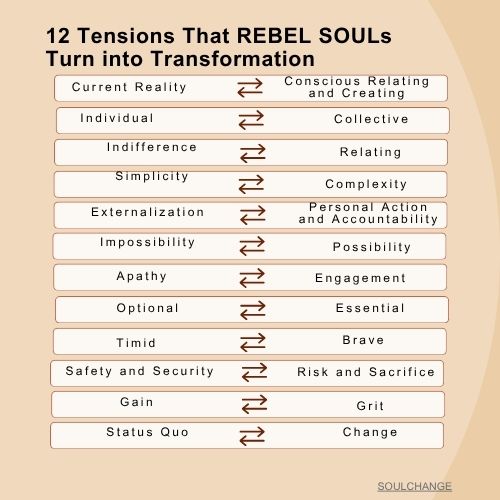
The rebel soul is invited to navigate at least twelve tensions.
- Current Reality vs. Conscious Relating and Creating
- Individual vs. Collective
- Indifference vs. Relating
- Simplicity vs. Complexity
- Externalization vs. Personal Action and Accountability
- Impossibility vs. Possibility
- Apathy vs. Engagement
- Optional vs. Essential
- Timid vs. Brave
- Safety and Security vs. Risk and Sacrifice
- Gain vs. Grit
- Status Quo vs. Change
By staying with the tensions despite the discomfort, rebel souls can cross the threshold of transformation, gain inner authority of soul, and make gains toward becoming better selves, creating better lives, and contributing to a better world..

Rebellion Is Not Simply About Behavior
A rebel soul isn’t defined so much by what they do on the surface. You can follow a traditional path and still be deeply rebellious. You can live unconventionally and still be conforming to a lower level of conscious relating and creating.
Because, rebellion at its core is not simply about behavior.
What separates a rebel soul from everyone else isn’t boldness or originality. It’s capacity.
Among other things, the capacity to turn tension into transformation.
Ultimately, this means staying present and moving through when most people collapse into:
- Avoidance
- Approval seeking
- Conformance
- Defensiveness
- Disregard
- Performance
- Rejection
A rebel soul feels the same or more tension than everyone else.
The desire to belong.
The fear of being wrong.
The discomfort of uncertainty, loss, risk.
The not knowing how to move through something.
The weight of expectations.
The pull to matter.
But instead of immediately resolving that tension by avoiding, pleasing, proving, conforming, or otherwise stepping back to safety, they stay with it and turn it into transformation. That changes everything, and it changes them.

Twelve Tensions That Can Shape a Rebel Soul
A rebel soul is formed in the space between conflicting forces. They certainly recognize there is an easy side compared to the hard side. But they don’t choose the easy side the way most people do. In many ways their rebellion is more daring. They stay in the tension and either hold both sides or they choose the hard side (to the best of their ability) even though it’s more difficult. In doing so, they experience more tension and can turn that tension into transformation.
There are least twelve kinds of tension that can shape a rebel soul.
Current Reality versus Conscious Relating and Creating
The overarching tension for a rebel soul is the misalignment between current reality and the foundational imprint in their soul of what conscious relating and creating is and what it looks and feels like.
They feel the gap between what’s happening in the present and its opposite in terms of what is whole and healthy, along with the future implications, and this tension fuels them.
Individual versus Collective
It’s easy to stay focused only on one’s personal life. In fact, the larger western culture encourages a certain amount of this self-centredness.
It’s harder to recognize that individual choices affect others, individual ways of living are part of larger systems, and individual voices contribute to shaping culture.
A rebel soul expands beyond self-focus. They expand their path by becoming more conscious of their impact within it and expand it to consider beyond themselves.
Indifference versus Relating
Sadly, it’s fairly common to be or become indifferent to the inequality, injustices, suffering of others, or the state of the world because we are so absorbed in our own lives, we have become desensitized, or we think there’s nothing we can do.
The rebel soul actively counteracts this with intentional and empathetic relating. They see and do their best to relate to the inequality, injustices, and suffering, and the state of the world even though doing so is not easy and leaves them with painful awareness, angst, and the struggle to figure out what they might do in response.
Simplicity versus Complexity
Many of us like to stay where things are simple and easier to make sense of, or even a little shallow. You know, the place where A causes B and quick fixes abound.
The rebel soul resists such simplicity. Instead, they do their best to hold complexity and the tension that inevitably results. They come to learn about systems, and how everything interacts with and affects everything else, within an individual, a family, a community, an organization, or a society. They may choose simple solutions, but it is based on understanding the complexity first and what is more likely to be meaningful in the long-term.

Externalization versus Personal Action and Accountability
Whether we recognize it or not, we all engage in a fair bit of externalization. We blame others for the conditions of our lives and their own lives. We tell ourselves that whatever is happening in our lives, our families, our communities, and our world is somehow not our responsibility.
The rebel soul holds it differently or learns to do so over time even though it’s uncomfortable. They resist the temptation to externalize and instead focus on taking appropriate personal action and accountability. They don’t want to be free from expectations—they take ownership of how they live, what they choose, and what they create. They regularly explore what needs changing in themselves and their work to relate and create more consciously.
Impossibility versus Possibility
There are many who are easily deterred in the face of what appears as impossibility, especially when things are deeply rooted. If they can’t immediately see that what is presently believed may not be everything there is to know or that a different ending might be possible, they basically accept the impossibility and learn to live within it.
The rebel soul resists this notion. They hold possibility even when it feels impossible to do so. They are active with their possibility —they seek other perspectives, and more information, and imagine a different future. They are not naïve in believing that the belief in possibility alone results in change. But on some level, they understand that without that belief, it is impossible to do the necessary things to move into the actuality of change.
Apathy versus Engagement
There seems to be a lot of apathy for the state of things. Apathy can be very comfortable, if not numbing on some level. Sometimes it involves keeping ourselves distracted by other things or simply staying content to live life from a place of unknowing or observation.
The rebel soul doesn’t seek much distraction, which supports them to move toward the tension of engagement over apathy. They show up. They get involved. They speak up. They challenge things. They commit. They join or organize others.
Optional versus Essential
Our larger culture particularly in the western world (although it’s spreading) has become very filled, even inundated, with stuff, activities, entertainment, information, messages, expectations, promises. There is an overload of things pulling on our attention, interest, time, and resources that seem important and sometimes even urgent, partly because of how they are marketed to us. Most of it is optional, although it may take us a while to realize this is the case.
The rebel soul struggles in the tension of overload just like everyone else. They come to see that it doesn’t really align with conscious relating and creating. They recognize that it isn’t good for them personally and is partly preventing any movement toward them creating better lives and contributing to a better world. Through time and intentional choice, they hold on to only what is essential.

Timid versus Brave
Most of us have a tendency to be a little timid. We might be confident in some areas where we’ve gained capability, but when it comes to moving through transformation, we’re cautious and resistant, which blocks the transformative process.
The rebel soul experiences tension when it’s time to move past the ways they are timid. They don’t usually start off brave, but they choose the brave thing again and again, not perfectly, not consistently, but enough that their bravery starts to fuel their transformation. Through the process of navigating tension and moving through transformation repeatedly, they become braver around bigger and bigger things. At this point, it might even look like they’ve been brave all alone.
Safety & Security versus Risk and Sacrifice
Fundamentally, our nervous systems are wired for safety and security, so we make choices consciously and subconsciously to have it, keep it, or regain it if it’s been compromised.
The rebel soul is compelled to move toward the foundational imprint of conscious relating and creating while needing safety and security just as much as everyone else. In fact, they may have been surprised by the ultimate cost involved during their first rebellion. But they have come to understand and accept that transformation and conscious relating and creating involve varying degrees of risk and sacrifice. Risk of judgement, humiliation, rejection, failure, loss of relationship and connection, or being harmed are a few options. They may also need to sacrifice comfort, certainty, convenience, status, power, privilege, or resources. Sometimes it’s a little sacrifice, and sometimes it’s a lot. They don’t offer up the sacrifice, but they do hold to their convictions of what is right and necessary, their creative unfolding, and their course of rebellion in the face of sacrifice.
Gain versus Grit
Many seek easy goals and gains that require minimal effort, or are content to just live from day to day, letting things upfold however they might. They almost want something from nothing or from very little effort. That approach, while comfortable, doesn’t translate well to change in the direction of more conscious relating and creating. This kind of change is often a bit of an uphill battle, with only small gains initially, so more resolve is needed.
The rebel soul lives and grows in the tension of grit. They are continually gaining knowledge and learning, developing resilience, expanding integrity, and gaining tenacity as they move themselves toward becoming better selves, creating better lives, and contributing to a better world.
Status Quo versus Change
There are many who accept the status quo intentionally or simply by default for a variety of reasons. They function from beliefs that things get done the way they’ve always been done and will be how they’ve always been.
The rebel soul encourages change, accepts change, and initiates change. That doesn’t mean they dono’ feel growing pains as part of change. They absolutely do. They simply stay in the tension because they know that betterment requires change; little change, big change, change to self, changes to relationships, changes to areas of life, changes to communities, changes to systems, and changes to societies.
Why Tension Matters for the Rebel Soul
Let’s face it, holding tension is difficult. It feels uncomfortable, uncertain and even vulnerable.
There are no clear scripts. No immediate validation. No guarantee you’re “doing it right.”
And without those things, the personality looks for relief. It wants safety, certainty, control, identity, and approval.
So, it pushes us to resolve tension quickly and most people listen. They turn back rather than staying with the tension and eventually crossing the threshold.
A rebel soul learns not to. They learn to stay with the different tensions, not as an idea—but as a lived experience. And so over time, they learn to:
- be less reactive and more deliberate.
- trust in what conscious relating and creating looks and feels like.
- be less defined by roles and more defined by alignment.
- rely on the inner authority of soul.
- tolerate and brave through more and more tension.
And all of this supports them to move toward relating and creating more consciously —while staying present inside the tensions.
Takeaways About Turning Tension Into Transformation
- Being a rebel soul is not about the surface behaviors such as resisting or speaking up. It’s more about navigating internal (and sometimes external) tension.
- While tension is part of everyone’s journey, the rebel soul learns to relate to it differently.
- Where most people pull back in the face of tension, the rebel soul learns to stay with it and turn it into transformation.
- The rebel soul navigates at least twelve tensions including: current reality vs. conscious relating and creating; individual vs. collective; indifference vs. relating; simplicity vs. complexity; externalization vs. personal action and accountability; impossibility vs. possibility; apathy vs. engagement; safety and security vs. risk and sacrifice; optional vs. essential; timid vs. brave; gain vs. grit; and status quo vs. change.
- The more the rebel soul stays present in the tension, the more they are positioned to create transformation toward becoming better selves, creating better lives, and contributing to a better world. They also gain increasing internal soul authority.
The Real Question
Instead of asking: “Am I a rebel soul?”
Some better questions might be:
“How well am I able to stay in these tensions and where do I collapse in the face of them?”
“What would it look like to stay present in the tensions instead so that I can keep moving toward more conscious relating and creating?
Because that’s where a rebel soul is formed.
Not in dramatic acts of defiance (although that may happen sometimes).
But in the quiet, difficult moments of staying in the tension so transformation is possible.
Rebellion isn’t about standing outside the world.
It’s about learning how to stand within it—
without compromising or handing over your internal soul authority.
And that begins, simply, with the willingness to stay in the tension.
With Humility, Hope, and Heart,