

Some souls don’t come into this world to fit neatly inside inherited systems, unquestioned assumptions, or limiting identities. The rebel soul attunes to a deeper imprint — a foundational imprint that calls them toward transformation, expansion, and meaningful contribution.
This imprint is not rebellion for rebellion’s sake; it is an evolutionary pull to become more fully and deeply ourselves while helping shape a more conscious and compassionate world.
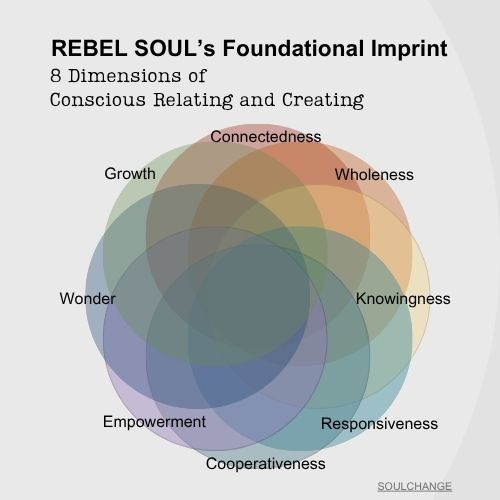
At the heart of this soulprint are eight living dimensions that guide the rebel soul’s unfolding (and rebellions): growth, knowingness, empowerment of self and others, connectedness, cooperativeness, responsiveness, wholeness, and wonder. All together, these dimensions form a dynamic map of being and becoming — one that refuses fragmentation, welcomes transformation, moves toward evolution and invites us to live with courage, curiosity, and purpose.
Related Posts: This is part of a series about the REBEL SOUL. Click here for clarification on what I mean by SOUL.
Eight Dimensions of the REBEL SOUL’s Foundational Imprint
The rebel soul attunes to the soul’s foundational imprint of conscious relating and creating, which is comprised of eight living dimensions.
- Growth
- Knowingness
- Empowerment
- Connectedness
- Cooperativeness
- Responsiveness
- Wholeness
- Wonder
The rebel soul’s attunement to the foundational imprint is not perfect or complete, but something they move into throughout their lives and development. They experience a gap between who they are, how things are, and this imprint, which motivates them to try to close the gap through various rebellions, big and small, personal and communal.
Some Notes About Determining and Defining the Dimensions
Before diving into the eight dimensions, I want to preface a few important things in terms of how they were determined and defined.
They are my offering of what sits at the core of the soul besides simply being in pure peaceful presence and unaffected existence. They are reflective of conscious relating and creating, because everything is about relating and creating.
Every moment. Every thought. Every perception. Every belief. Every hope. Every big idea. Every uncertainty. Every intention. Every plan. Every learning. Every feeling. Every family. Every organization. Every policy. Every rule. Every decision. Every word expressed. Every response. Every organizational structure. Every communication. Every action and reaction. Every mistake and misstep. Every regret. Every celebration. Every new beginning. Every ending.
Everything is about how we relate to and create whether its within ourselves, with others or within the larger world (including the environment).
“Every problem is a problem of consciousness” Egyptian Proverb
Now the fact that we may not be consciously engaged in the process of relating and creating does not take away from the truth that at the centre of everything is relating and creating.
And let’s face it. The soul is only going to be involved in things that are either coming from consciousness or moving us toward more consciousness.
There are many different ideas and opinions on what consciousness means in terms of relating and creating. Indeed, some of those have informed my view on the matter. I don’t claim to have the definitive answer because I am not sure there is one. I have distilled it down to eight intertwined dimensions. My sense keeps shifting ever so slightly as I learn and grow and move further along the path.
They are, of course, limited by my limitations- they can’t not be. They can only reach as far as I am able or that I can envision is possible.
They are but one way of organizing things. I spent many years refining these eight on the side of my desk so to speak. I poured through journal articles, spiritual texts and resources, my own experience, and that of others. There were hundreds of sticky notes in multiple sizes being organized and reorganized and reorganized some more. Some of the bigger influences on my thinking are recognized here.
An overview of each Dimension is provided along with some subcategories of what the dimension consists of. Hopefully, this is enough for you to get a sense of them.
Rebellion as Development
While these dimensions may be imprinted on the soul, the vast majority of us do not function primarily as soul. We function primarily as human personality, including sometimes wounded personalities that are stuck in survival, trauma and personality disorders. So, our attunement to, alignment with, and embodiment of these dimensions of conscious relating and creating is by no means a given. As much as we might like, we cannot simply transcend the personality and become the soul (although there are reports of some people who have had the experience of their personalities dissolving, which allowed for alignment with the soul either temporarily or permanently- see Taylor in SOURCES). Most of us, including myself, must journey to try and move there with much flailing, failing, and falling down.
These dimensions are the big picture end result. As they are scaffolded upon and emerge from the coming together of much development and many capabilities, they are invitations into rebellion. For example, among other things, cooperativeness requires empathy and is built upon and comes together from first developing relationality and civility. There is no getting around this. We must move through smaller rebellions repeatedly to attune with, align to, and embody cooperativeness.
The dimensions are not separate or standalone. They are intwined. For example, we cannot merely develop mindfulness and call ourselves conscious. That mindfulness must be expressed with wisdom, recognition and care for others, and accountability for all.

Connectedness
Connectedness is a healthy, love-filled experiencing, embracing and living from the interrelatedness of all things within the self, with others, with the larger world, and with the sacred in whatever form that is experienced.
Call of Rebellion: refusal of isolation and disconnection while immersing into loving, expansive interconnectedness that requires healthiness and allows for individuality.
Sensing as:
- Experiencing the felt sense within ourselves that simultaneously draws upon our various parts and aspects, all our experiences, and all of our knowings.
- Paying attention to the experience of others and the dynamics of relating within relationships.
- Attuning to other surroundings, the natural world, and the sense of the sacred.
Openness relative to:
- Holding our beliefs, thoughts, feelings, state, vulnerabilities, actions and interactions within and toward ourselves, others, relationships, the natural world; as well as the sacred.
- Being unhindered because we are able to access and connect from our physical, emotional, psychological, social, and spiritual aspects rather than from only one or some of them.
- Developing awareness of our defenses and self-protections and an ability to relax them appropriately.
Continuity in:
- Being able to maintain an inner state of connection/interconnection with oneself and outside of oneself absent of significant dysregulation.
- Tolerating or withstanding outside people and circumstances in a lower level of connectedness while continuing to hold to our own level of love and connectedness.
- Noticing, assessing and engaging in appropriate strategies in order to resume a state of connectedness/interconnectedness should disconnection occur.
Full-heartedness in terms of:
- Having an open heart, good intentions, and an ability to identify with and have a sense of care, concern, compassion and even reverence for self, others, and the larger world.
- Extending love, particularly unconditional love to ourselves, others, and the larger world, as well as the sacred.
- Limiting any expression of hatefulness in all its forms, toward ourselves, others, the larger world, and the sacred.
Synchrony for:
- Attuning to and within ourselves, others, and the larger whole, as well as the sacred, that expands through time and practice all the way to higher and holy levels of connectedness, that allows us to bravely stay even in the moments that are hard.
- Feeling and being part of a larger entity and interconnection such as a partnership, team, community, organization, society, and/or the overall sacredness of life.
- Having companionship and/or spirituality that helps one deal with reality in a way that transcends circumstances.

Growth
Growth is the process of change, healing, and transformation. “Growth” and “development” are often used interchangeably but are not the same. Most development occurs naturally and spontaneously through genetic encoding and as someone engages with life, has their primary needs met and interact with their environments. Growth is optional and is more than mere adaptability to change.
Call of Rebellion: refusal of stagnation or regression while seeking expansion and elevation.
Noticing by:
- Recognizing the inner pull that might arise as a deep sense of longing, gentle recognition that something has to change, or the deep pain of suffering.
- Listening for and attending to the subtle suggestions, invitations, connections, and guidance that are available through the growth process.
- Appreciating the signs of growth (changes in our felt sense, welcome surprises, handling situations differently, tipping points, etc.) and using them to move ourselves forward.
Humility through:
- Recognizing that most people, ourselves included, and their ways of being, capabilities, and circumstances are limited but not static.
- Being able to invite and embrace constructive feedback and criticism and having openness in acknowledging perfections and places requiring growth, owning mistakes, and failures.
- Softening or allowing the slipping away of the ego or the personality and any defenses to growth that might arise.
Willingness in terms of:
- Letting go of control and current reality in order to hold things with an open stance, and give them space and room to move and shift into what is emerging.
- Befriending the uncomfortable processes of growth (discomfort, uncertainty, loss and letting go, fear, feelings of incompetence, the need to start over, being overwhelmed, etc.)
- Surrendering into what is trying to come forth or be birthed within us or our lives, allowing for what is unstructured and unscripted and exploring the musings and potential pathways of change.
Hopefulness by:
- Believing that the process of growth will lead to betterment of some kind of other side, even when we cannot yet find evidence of the unfolding.
- Finding or maintaining inner hope in the midst of long stretches of suffering, being in the void, losing connection, or facing a dark night soul.
- Intentionally cultivating hope, such as through inspirational stories, support from others, and envisioning betterment.
Effort that involves:
- Working to release and replace that which no longer serves, and shifting thoughts, feelings, actions, and comfort zones, and facing challenges.
- Striving to do things that we are not yet capable of, comfortable with, or confident in so that we gain new experiences, develop new capabilities, enhance ourselves, and become more conscious in our relating and creating.
- Navigating the hard parts when: everything we have known or believed comes into question; we have sincerely lost our way or do not know the way forward; there seems to be continual missteps, set backs, and failures; there is resistance from parts of ourselves, those around us or larger paradigms; or there are long stretches of suffering without much support.

Wonder
Wonder is a stance with life that reflects seeing and holding what is precious, glorious, and meaningful and allowing it to penetrate and enliven us.
Call of Rebellion: refusal of insignificance and meaninglessness while embracing the mundanely magnificent.
Beauty through:
- Noticing and taking in beauty in its many forms such as the harmony, colours, and loveliness of people, interactions, creative expression, and the natural world.
- Recognizing the beauty, even in the messiness of life.
- Using beauty appropriately in a manner that does not bypass ugliness in terms of disharmony, harmfulness, and oppression in its many forms.
Contentment by:
- Recognizing that in this moment we are enough, even though our lives may be incomplete and there is always more growth awaiting us and remembering that so long as our needs are consistently met that we also have enough in the simplicity of life.
- Seeing the good in life, the blessings as they arise and freely expressing humour, appreciation and gratitude for living, learning, and loving, without negating what is difficult and hard or depreciating or diminishing that which is good.
- Accessing the inner wellspring of peace and joy and enjoying the richness of life while resisting the impulse to fall into prolonged or chronic discontentment such that the experience of wonder might be closed off.
Playfulness through:
- Engaging in silliness, laughter, enjoyment, and child-like delight, that recognizes the context and situation and does not dishonour others.
- Recognizing the place for play relative to the need for seriousness and sorrow, and ensuring that one does not allow seriousness to prevail for so long that it sets in, and using play appropriately in a manner that does not bypass that which requires seriousness.
- Allowing ourselves to experience and express excitement about ourselves, others, life, the sacred, and the goodness and possibilities that each day beholds, including through celebration.
Inspiration that involves:
- Noticing and connecting with that which has awe or holds potential and possibilities, including with praise.
- The use of imagination and creativity to produce original ideas or to bring existing ideas into new forms.
- The ability to enter the “flow state” in which expression spontaneously flows out of us and we are immersed in the delight of activity and/or creativity.
Mystery through:
- Living in acceptance, deep respect, and love for all of life and for the source of life.
- Beholding the magnificent unknowns of life that come in many forms, whether it is the uncommon, the unseen, the synchronicities, the symbolism, the everyday phenomenon that is seemingly beyond explanation, the unexpected turn of events that brings blessings, the miraculous, or even in the trusting of the mystery that is beyond what we might ever experience or know.
- Staying true to the bigger unfolding in life through wandering, exploring, seeing anew, and by leaning to see and experience more and more while holding faith in life and ourselves within in.

Empowerment
Empowerment is an individual stance of authentic worthiness, claiming needs and rights and gaining courage, confidence, and capability, while affording and supporting the same to all others, inclusively as individuals, as well as within systems, structures and paradigms.
Call of Rebellion: refusal of inequality, oppression and exploitation while equitably existing with or elevating self and all others.
Equality in terms of:
- Believing in and acting from the innate dignity, value, and worthiness, of ourselves and all others.
- Accepting of and exercising of one’s responsibilities relative to ensuring basic rights and freedoms of ourselves and all others.
- Developing awareness of one’s own stance of power relative to the equality of basic rights and freedoms relative to others e.g., diminished, disregarded, superior, regarding, honouring, etc., and a commitment to maintain or move oneself to a stance of regarding all others as equal.
Assertiveness that is:
- Continually emerging into various aspects of one’s own personal and interpersonal power, meeting of needs, and claiming of rights, while helping others to emerge into various aspects of their power.
- Recognizing and understanding the domains of power (Collins & Bilge) including: i) interpersonal power whereby individuals interact and relate to one another across various advantages and disadvantages; ii) disciplinary in how the rules work, how power operates to “discipline” people’s lives through options afforded or not afforded to them or through punishment; iii) cultural power in the ideas and messages that shape our understanding of difference and power; and iv) structural power as the mutually reinforcing relations of gender, race, class, sexuality, nation and social institutions.
- Developing awareness of one’s own stance of power regarding the meeting of needs and claiming of rights relative to others e.g., oppressive, aggressive, controlling, entitled, competitive, directive, cooperative, collaborative, assertive, allyship, advocative, etc. and commitment to maintain or move oneself to utilizing power without trampling on the needs and rights of others.
Inclusivity that involves:
- Believing in and acting from inclusion of self and others.
- Recognizing and understanding of the different types of inclusion e.g., physical, intellectual, social, etc., and degrees of inclusion that are possible, from exclusion to meaningful inclusion that is integrated in structures and systems.
- Developing awareness of one’s own stance of power relative to inclusion and participation relative to others e.g., excluded, controlling, delegation, manipulation, placation, informing, consultation, invited, partnership, accepted, etc. and commitment to maintain a stance of meaningful inclusion or moving oneself in order to do so.
Intersectionality in terms of:
- Learning about and recognizing the significant identity and social location disparities of empowerment that have existed historically and presently and understanding their profound impacts, harm, and longer-term legacy.
- Using an intersectional lens that holds all identity and social location disparities simultaneously rather than singularly or separately.
- Carefully examining one’s own social location including the sameness and differences as well as advantages and disadvantages with others and allowing that awareness to integrate and reshape one’s views about self, others, and the way power truly works in the world.
Justice relative to:
- Believing in and acting from overall justice, making changes in one’s thinking, perceiving, feeling, and actions to reduce or remove one’s conscious or unconscious participation in and contribution to larger systemic inequities and harms that are happening close to home or in the larger world, while recognizing that the ultimate assurance exists beyond our control.
- Engaging in activities (preferably alongside those affected) aimed at dismantling unjust power positions and structures, and liberating individuals and groups who have been or are disempowered because of certain identities and social location e.g., speaking up, challenging the status quo, pushing for progress, resisting, boycotting, marching, funding, campaigning, etc.
- Supporting the importance and necessity of participating as appropriate in the reparation for harm caused from social disparity and disempowerment.

Cooperativeness
Cooperativeness is a stance of accepting the current unfolding and coming together from mutual honoring, understanding, and contribution in the pursuit of achieving something with many possible variations.
Call of Rebellion: refusal of antagonism while helpfully creating and co-creating with others for mutual benefit.
Acceptance by:
- Coming from a foundation of okayness regarding ourselves, others, and circumstances or situations, as well as the current unfolding of life, including what is both seemingly positive and negative, which not only supports an internal state of peace but cooperativeness with what is.
- Turning toward what is potentially or actually wrong, harmful, unhealthy, and not working, so that we are cooperating with and from the current reality rather than rejecting it, and are thus best positioned to create change.
- Facing and coming to terms with reality and hard truths about ourselves, others, circumstances, and life.
Expectancies with:
- Having clear and clarified expectancies with ourselves for making considerable effort to meet our own needs and only expecting others to meet some of our needs, some of the time.
- Deliberately matching ourselves to circumstances, relationships, and situations that are usually capable of meeting our reasonable and legitimate expectancies and adapting ourselves during unusual or difficult times.
- Knowing when to stand apart from cooperativeness because the circumstances or individuals involved are significantly lacking in many of the other dimensions of conscious relating and creating.
All-Centredness in terms of:
- Using an expansive focus that extends well beyond the self, to all involved and affected others, as well as the larger world, including the environment.
- Resisting any temptation for self-centredness or a focusing on the self or few while disregarding some of the involved or affected others.
- Recognizing and considering the needs, impacts, and consequences on ourselves, others, the larger world, and the sacred.
Contributing through:
- Inviting and accepting the contribution of any, some, or all those involved and affected.
- Coming from a state of generosity toward self and others that reflects goodness, and trust with appropriate discernment.
- Giving that which is legitimately needed and might be shaped as service, charity, donation, supports or other altruism that bears some of the weight some of the time because no one fully stands on their own at all times.
Uniting by:
- Recognizing that we need others and others need us by design and thus leaning in and linking to others, to the larger world, and to the sacred.
- Pooling and making best use of perspectives, people, diversity, education, knowledge, abilities, talents, ideas, resources, etc.
- Bringing everything supportive together and working alongside others toward a common purpose and actions in support of the goal and the whole.

Responsiveness
Responsiveness is intentional involvement and love in action with consciousness and full accountability for our intentions and results in all directions (while qualifying what is in our control).
Call of Rebellion: refusal of complacence, reaction, and unaccountability while progressing in conscious intention and impact.
Non-Reactiveness that involves:
- Effectively handling things from calmness and consciousness, rather than automatically, unconsciously, or with extremeness, through the ability to stay present, settled, and regulated within ourselves.
- Regarding difficulties, challenges, and problems as being surmountable, such that one is able to bring forth fearlessness, confidence, creativity, openness, flexibility, and faith in developing solutions and finding resolutions.
- Holding a stance of detachment to ensure we are not too invested in a certain way of perceiving, understanding, and responding to things, or regarding a preferred outcome, but are able to hold our views and expectant outcomes loosely enough to provide intellectual, emotional, psychological, spiritual, and social space for unfolding.
Intentionality in terms of:
- Being clear with our intent on how we are wanting to relate, what we are intent on creating, and what is motivating us as we are doing so.
- Envisioning through the purposeful use of one’s imagination, thoughts, felt sense, and energy to influence, cultivate, and elevate how one is responding and what you are creating both individually and collectively.
- Holding the frame of one’s longer-term legacy and its impact as we consider and take actions with ourselves, important others, the areas of our lives, our communities, the larger society, and the environment, both now and throughout many years and even generations to come.
Engagement by:
- Leaning in and bringing the fullness of who we are, what we have, and what we are capable of, and not holding back (unless it is appropriate to do so in select circumstances) by stepping more into ourselves, our relationships, our lives, and the world, rather than leaning out or moving away from it.
- Weaving our receptive and emergent abilities in the process of relating, creating, and using or developing one’s capabilities however needed to move toward one’s directed or desired actions and outcomes as we respond to ourselves, others and circumstances.
- Exercising strength in the face of threat, challenge, and danger and resilience in response to obstacles, rejection, failure, and adversity, including tapping into a deeper well of endurance.
Progressiveness through:
- Taking necessary and appropriate action toward goals, including those that others would find overwhelming, through taking risks toward what is important, moving through and managing fear, trying new things, being vulnerable, and continually moving toward possibilities.
- Demonstrating righteousness and doing what is most right rather than doing what is easy, safe, comfortable, or convenient without regard for benefits or outcomes, while exercising the necessary hardiness (determination, patience, delayed gratification, impulse control, falling down and getting back up) so that full intentions are realized.
- Drawing on unreasonableness and pushing for changing in the face of that which is not conscious relating and creating within oneself, others, and the larger world, while seeing beyond into new ways, new approaches, new possibilities.
Answerability that includes:
- Practicing ongoing self-awareness and reflection relative to our intention and what is unfolding by noticing what is happening both within us in terms of guidance, thoughts, and feelings, as well as our actions and the circumstances, and addressing any discrepancies as they arise, whether it is because of fear and self-protection, a change of heart, gaps in our capabilities, a lack of resources or supports, unresolved concerns, or unexpected emergencies, etc.
- Recognizing the true impact of our relating and creating in terms of thoughts, choices, words or actions, whether intentional or not toward ourselves, others, our lives, aspects of the larger society, and physical environment, both now and in the future.
- Developing a responsiveness backbone committed to conscious relating and creating that routinely asks “what is/was my responsibility to myself, others, the situation, the larger world?” and living in the response both through celebrating successes and missteps (whether intentional or not) and redoing, fixing, and making amends as necessary.

Knowingness
Knowingness is an expansive evolutionary process in relationship to fuller, deeper, and richer experience with awareness, truth, and understanding.
Call of Rebellion: refusal of disinterest, denial and ignorance while deepening one’s experience of lived wisdom and truth.
Awarefulness in terms of the:
- Ability to bring oneself to and be in the present moment with what is currently occurring within us, around, and/or beyond us.
- Sensing, noticing, and attending to the soma (bodyfulness), heart (heartfulness), mind (mindfulness), soul (soulfulness) and the surroundedness of others and environments.
- Apprehending our knowing sense without judgement.
Curiosity expressed as:
- A strong sense of interest and desire to know or learn something about ourselves, a topic, a situation, others, the world and how it works, and what is not yet known or understood in an open minded and non-judgmental way.
- Use of all faculties and being fully active with open-mindedness, exploration, inquiry, enhanced thinking, contemplation, and alertness in perceiving and drawing inferences, while recognizing tendencies and short cuts such as relying on past patterns.
- Mining one’s experiences and exposures to cultivate what has value and its meaning.
Clarity obtained by:
- Maintaining objectivity about ourselves, others, situations, and circumstances particularly when we have a vested interest.
- Perceiving others and circumstances without distortion from extreme beliefs, emotions, or illusions, and recognizing one’s own preconceptions and biases while seeking deeper understanding.
- Using recognized and accurate observation, insight or intuitive understanding to further perceptiveness.
Illuminating relative to:
- Emptying one’s current way of thinking to explore all available information and knowledge (internal and external, direct or intuitive) with open-mindedness, inquiry, enhanced thinking, and contemplation in perceiving and drawing inferences, while recognizing tendencies and short cuts (such as relying on past patterns and biases) in order to increase perception and understanding, and while knowing there is always more that we do not yet see, sense, know, or understand.
- Looking beyond, including through deconstruction, what is presented, apparent, or believed in as part of continually move toward deeper, fuller and higher truth beyond the five senses, prevailing paradigms, and illusion into the complex underlying causes of individual and systemic suffering.
- Regularly freeing ourselves from influences, viewpoints, and attachments that keep us from being true to ourselves, doing what’s right, becoming more conscious, creative, or capable, and allowing the uncomfortable cracking of long held beliefs (e.g., accepting that things are not on our terms, recognizing that justice, order, and chaos do not revolve around us, realizing we have actual limitations in the physical/human world, reconciling paradox, moving beyond motivations of comfort and safety, turning into what is dark, dysfunctional, and hard to face, as well as what is light, love, universal, and hard to believe).
Discernment through:
- Engaging in the process of determining and utilizing what is important, essential, vital, significant, meaningful, and/or relevant.
- Accessing and listening to the wisdom of others.
- Generating one’s own wisdom by applying or integrating knowledge, experience, conscience, values, virtues, and higher knowing and deeper truth in one’s sensing, perceiving, thinking, decisions, and actions.

Wholeness
Wholeness is recognizing and holding the whole, as well as the parts and ecology of the whole and their relationship to one another, while seeking a state of fullness, completeness, and unity, not just within ourselves as individuals but in our lives and the larger world.
Call of Rebellion: refusal of fragmentation and reductionism while reaching for integration and holism.
Regarding by:
- Maintaining all aspects of the whole, without reducing or removing parts or aspects, and/or using a reduced number of parts or aspects while claiming that they are in fact reflective of the whole.
- Valuing, embracing, and including all parts, even when doing so is messy and problematic.
- Engaging in the continual pull and movement toward what is more whole, including the spiritual, by bringing ourselves forth in our many dimensions, gains, and glory, as well as our works and wounds so that we can connect as deeply as possible with others and life.
Balancing through:
- Knowing the importance of moderation for overall wholeness and living from it.
- Maintaining overall balance or equilibrium within the self, life, relationships, and the world while understanding that it is sometimes necessary to move out of balance due to extenuating circumstances or to support a significant shift and ultimately create high order balance.
- Recognizing imbalance when it occurs and engaging in rebalancing as soon as possible to support overall wholeness.
Healing in terms of:
- Recognizing that wholeness can be thwarted for many reasons, and that no part can be well unless the whole is well, and the whole cannot be truly well unless the parts are well.
- Engaging in the process of restoring and restorying any and all wounding that has resulted in smallness, fragmentation, shattering, disconnection, dissociation, or a splitting apart of the connection to the self at all levels and in all directions, etc., and internalizing the growth that comes from healing traumas and failures.
- Transmuting beyond lesser versions of ourselves into higher levels of consciousness and beyond lesser paradigms into higher paradigms of relating and creating.
Interrelatedness related to:
- Seeing things as systems that allow for the recognition of how the parts or aspects that make up the whole are connected, affecting, and interdependent.
- Deliberately seeking that which is not yet seen, recognized, and known as part of understanding complexity and interconnectedness.
- Engaging in an ongoing process of adjustment in response to the changing of self, life, others, circumstances, and the world, that, due to the larger interrelatedness, means that change anywhere in the system reverberates in all directions.
Integration related to:
- Supporting synergy by combining or melding some parts with one another such that the melding results in further enhancement and expansion that would not have been possible had the melding not taken shape.
- Weaving together parts or aspects in a manner such that they are associated, undivided, unbroken, and function smoothly together or as one.
- Ensuring that who we are within ourselves and in our outward actions aligns with our best holding of the whole, including valuing and upholding our deepest knowing, guidance, values, and beliefs without compromise at any given time.
Why the Foundational Imprint and Dimensions Matter
While this categorization is only one option, the eight dimensions of conscious relating and creating provide language and labels for the foundational imprint that is primarily experienced as a deeply held soul sense. It provides a map of sorts in terms of understanding the motivation to rebellion for the rebel soul. It also outlines the ultimate goal in conscious relating and creating.
Takeaways About the REBEL SOUL’s Foundational Imprint
- The rebel soul is attuned to a foundational imprint of conscious relating and creating that provides a blueprint for being and becoming.
- The foundational imprint has eight dimensions of conscious relating and creating, including: connectedness; empowerment; wonder; growth; cooperativeness; responsiveness; knowingness; and wholeness. The dimensions are interwoven. Focusing on any one of them to the exclusion of the others leads to less conscious relating and creating, not more.
- Attuning to and expressing the dimensions of conscious relating and creating is scaffolded upon many areas of human development and capability physically, mentally, emotionally, spiritually, and socially.
- The need to move closer to the eight dimensions inspires and motivates the rebel soul to engage in many small (and sometimes big) personal and communal rebellions to become better selves, create better lives and contribute to a better world.
- Embodying the dimensions of conscious relating and creating is a work in progress that involves a lifetime, if not more. Hopefully, this overview gave you a better sense of what it means to be a REBEL SOUL. Perhaps you saw glimpses of yourself in the descriptions.
Here’s a few closing questions to help personalize the eight dimensions for you.
How do these eight dimensions resonate with the foundational imprint on your rebel soul?
Which of the dimensions do you most recognize in your journey thus far?
Which dimension has your developmental focus right now?
With Humility, Hope, and Heart,

SOURCES:
Hill Collins, P. (2008). Black feminist thought: Knowledge, consciousness, and the politics of empowerment (2nd ed.). Routledge.
Hill Collins, P., & Bilge, S. (2020). Intersectionality (2nd ed.). Polity Press.
Taylor, S. (2012a). Spontaneous awakening experiences: Beyond religion and spiritual practice. Journal of Transpersonal Psychology, 44, 1, 73–91.
Taylor, S. (2017). The leap: The psychology of spiritual awakening. New World Library.
Taylor, S. (2018). Two modes of sudden spiritual awakening? Ego-dissolution and explosive energetic awakening. International Journal of Transpersonal Studies, 37, 2, 131–143.
Taylor, S., & Egeto-Szabo, K. (2017). Exploring awakening experiences: A study of awakening experiences in terms of their triggers, characteristics, duration and after-effects. The Journal of Transpersonal Psychology, 49, 1, 45–65.